

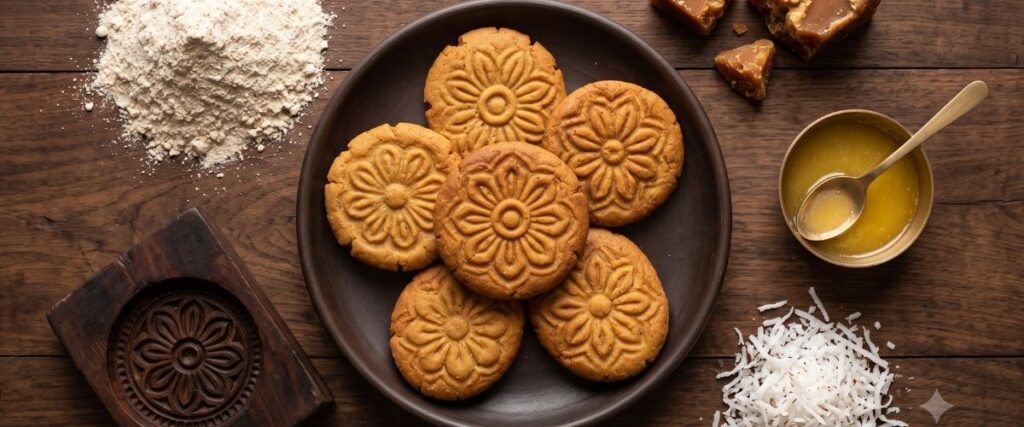
Quick Reference
| What it is | Traditional fried sweet from Mithila, Bihar and Nepal |
| Main ingredients | Chakki atta, jaggery or sugar, desi ghee, dried coconut |
| Shape | Round or oval disc, pressed with a carved wooden mould (sancha) |
| Texture | Firm, crunchy, dense |
| Shelf life | 90 days at room temperature, no preservatives |
| Alternative names | Khajuria, Tikari, Thokwa, Thokni, Thekariis, Kajuriya, Khajur, Thikri |
| Regions | Bihar, Jharkhand, eastern UP, West Bengal, Nepal (Madhesh, Lumbini, Koshi) |
| Cultural occasions | Chhath Puja (primary), everyday snacking, gifting, journeys |
| Frying medium | Desi ghee (authentic), oil (some variations) |
What Is Thekua?
Thekua is a traditional deep-fried sweet snack from the Mithila region of northern Bihar, India, and southern Nepal. It is made from stone-ground whole wheat flour (chakki atta), block jaggery or sugar, and pure desi ghee, pressed into a round or oval disc using a hand-carved wooden mould called a sancha, and fried slowly in ghee until deep golden brown.
It has a firm, dense, crunchy texture that does not soften when dipped in chai. It lasts 90 days at room temperature in an airtight container without any preservatives. It is eaten as an everyday snack, offered as prasad during Chhath Puja, packed for long journeys, gifted across communities, and presented by PM Narendra Modi to Slovakia’s Parliament Speaker as a diplomatic gift in June 2026.
Full background on what thekua is and where it comes from →
What Does “Thekua” Mean?
The word thekua comes from the Hindi verb thokna, meaning to hammer or to press. The original word was thokua (thoka hua, that which has been pressed), which over time became thekua.
The name describes the making process precisely. Thekua dough is pressed firmly onto a carved wooden mould to transfer the pattern onto the surface. The act of pressing, of hammering the dough into the mould, is what gives the food its name. It is one of those words where the etymology is the recipe.
Where Does Thekua Come From?
Thekua originates from Mithila, a cultural and linguistic region defined by the Maithili language, spanning northern Bihar and southern Nepal. The Kamala, Gandak, and Koshi rivers define its geography more accurately than any administrative map.
It is popular across Bihar, Jharkhand, eastern Uttar Pradesh, West Bengal, and three provinces of Nepal: Madhesh, Lumbini, and Koshi. The same food, made the same way, exists on both sides of the India-Nepal border because the region it comes from has never been divided by the borders drawn around it.
Most descriptions call thekua a “Bihari sweet.” That is accurate at the administrative level. Mithila is the more precise cultural origin, and precision matters because Mithila has a distinct culinary tradition, language, and food philosophy that differs from the rest of Bihar. Calling thekua a Bihari sweet is like calling Champagne a French wine. True, but incomplete.
The story of Mithila and why it matters for understanding thekua →
The Alternative Names of Thekua
Thekua is known by several names across regions, communities, and generations:
Khajuria / Kajuriya / Khajur — the most common alternative name, used widely across Bihar and by the diaspora. Some argue khajuria and thekua are slightly different products (thekua uses jaggery syrup, khajuria uses sugar syrup, or vice versa depending on who you ask). In practice, the names are used interchangeably in most regions.
Tikari / Thikri — used in parts of Bihar and Jharkhand.
Thokwa / Thokva — closer to the original etymology (from thokna), used in some communities.
Thekariis / Thokni — less common variations, found in specific districts and in Nepal.
The existence of nine names for one food across a relatively compact geographic region tells you something about how old and how deeply embedded it is. Foods with one name are usually younger. Foods with many names have been around long enough for each village to develop its own word for it.
Thekua Ingredients
The authentic Mithila version uses four ingredients:
Chakki atta (stone-ground whole wheat flour): The base of the dough. Stone-ground, with the bran intact. The coarser grind absorbs jaggery syrup differently from packaged atta blends and produces thekua’s characteristic firm, roasted texture. Chakki atta contains roughly four times the fibre of refined flour (maida), which is why a thekua holds you longer than a biscuit.
Block jaggery (gur) or sugar: The sweetener, dissolved into syrup before being worked into the dough. The syrup method, standard in Mithila’s kitchens, gives even sweetness distribution throughout the dough. Jaggery produces a deeper, earthier sweetness and retains trace minerals (iron, potassium, magnesium) that refining removes from white sugar. The sugar variant produces a lighter coloured, slightly crisper thekua.
Desi ghee: In the dough and as the frying medium. Pure desi ghee, not vanaspati or refined oil. Ghee contributes both flavour (the warm, nutty aroma that makes thekua smell like a kitchen rather than a factory) and shelf stability (pure ghee lasts 9-12 months without preservatives, and its presence in the dough creates a fat barrier that limits oxidation).
Dried grated coconut (sukha nariyal): Specific to the Mithila version, dried coconut, worked into the dough in a measured quantity, rather than fennel or cardamom used in other regional variants. It adds a subtle crunch that runs through each piece. This detail is absent from most online recipes and is one of the clearest markers of authentic Mithila thekua versus regional adaptations.
Some recipes from other parts of Bihar and Jharkhand add fennel seeds, cardamom, or dry fruits. These are valid regional variations. The Mithila version uses dried coconut as the fourth ingredient and nothing else.
Full recipe with exact ratios, jaggery syrup method, and step-by-step frying guide →
How Thekua Is Made
Making thekua has three stages, each of which determines the outcome of the next.
The dough: Block jaggery is dissolved in minimal water over low heat into a syrup, strained of impurities, and cooled to room temperature before it touches the flour. Ghee is rubbed into the flour and dried coconut until the mixture resembles coarse crumbs. The cooled syrup is then added gradually until a firm dough forms — firm enough to hold its shape in the palm without sticking, stiff enough to hold the sancha pattern without collapsing.
The shaping: Each portion of dough is pressed firmly into the sancha mould and tapped out. The pattern transfers cleanly only if the dough is at the right consistency — too soft and it sticks; too dry and it cracks. Thickness must be consistent at approximately 1cm across every piece. Variation in thickness produces uneven frying.
The frying: Slow, in desi ghee, on a low flame, for 12-15 minutes per batch. Jaggery caramelises faster than refined sugar — a medium or high flame burns the exterior before the interior sets. The low flame is the step most home attempts get wrong, and it is also the step that produces the 90-day shelf life. Extended low-temperature frying drives almost all internal moisture from the dough.
Complete step-by-step recipe with troubleshooting guide →
The Sancha Mould
The sancha is a hand-carved wooden mould used to press thekua dough into a patterned disc. Traditional sancha designs carry geometric flowers, radiating petals, and mandala-like patterns that share their visual vocabulary with Madhubani painting — both are Mithila traditions drawing from the same design language.
The sancha does more than create the characteristic surface pattern. It standardises the thickness of each piece, ensuring consistent frying across a batch. A hand-pressed thekua without a sancha will vary in thickness; a sancha-pressed one won’t.
Sancha moulds are typically passed down through families. A homemaker’s sancha may be decades old, carved to the pattern her grandmother preferred.
The sancha — its history, connection to Madhubani art, and how to use one →
Types and Variants of Thekua
Jaggery Thekua (Gur ka Thekua): The most traditional version. Made with block jaggery dissolved into syrup. Deep amber-brown colour. Earthy, complex sweetness with mineral undertones. The Mithila standard.
Sugar Thekua (Chini ka Thekua): Made with white sugar syrup instead of jaggery. Lighter in colour — closer to pale gold than amber-brown. Slightly crisper texture. Sweeter in a more straightforward way, without jaggery’s earthiness. Popular in parts of Bihar and with buyers who prefer a milder sweetness.
Dry Fruits Thekua: A premium variant with chopped cashews, almonds, or pistachios worked into the dough. Heavier, richer, more textured. A gifting and festive variant rather than an everyday one.
Khasta Thekua: Khasta means crispy in Hindi. Some recipes use a combination of maida and atta, or add semolina (suji), to produce a lighter, crispier result. Purists argue khasta thekua is not authentic thekua — the traditional version uses only chakki atta and is meant to be firm and dense, not light and crispy. Both versions exist widely.
Regional Variations: Across Bihar, Jharkhand, and Nepal, minor variations exist in the spicing — some kitchens use fennel seeds, some cardamom, some both. The Mithila version uses dried coconut. The core of wheat, sweetener, and ghee stays constant across all variations.
What Thekua Tastes Like
The flavour of thekua is specific and does not resemble anything factory-made.
Jaggery thekua has a deep, complex sweetness, earthy and slow, with mineral undertones that refined sugar can’t replicate. The desi ghee adds warmth and a faint nuttiness. The whole wheat gives substance and a faint roasted quality from the frying. The dried coconut creates intermittent crunch that breaks up the texture.
The exterior is firm and holds its shape in chai without softening. This is by design. Thekua is meant to be bitten through, chewed, held. The texture is part of what makes it satisfying at 4pm in a way that a light biscuit isn’t.
When it comes out of the ghee, it smells like a kitchen. Ghee and jaggery, warm and specific — the smell of something made rather than manufactured.
How thekua compares to the biscuits most people eat at chai time →
Thekua and Chhath Puja
Thekua is the primary prasad offered during Chhath Puja,6 a four-day Vedic festival dedicated to the Sun God (Surya Dev) and Chhathi Maiya, celebrated across Bihar, Jharkhand, eastern UP, and the Nepali Terai. During Chhath, thekua is offered at riverbanks during sunset and sunrise rituals, distributed to devotees, and carried home as prasad.
It is preferred as Chhath prasad for reasons that are as practical as they are ritual: it is made from pure, minimally processed ingredients (wheat, jaggery, ghee), it can be made in large quantities at home, and it lasts long enough to be shared and transported after the festival. These qualities made it the natural choice for a four-day outdoor religious observance long before anyone thought of it as a “healthy snack.”
Chhath Puja also marks the point in the year when thekua gets the most visibility — search volume for “thekua” spikes every October-November during Chhath season and again during Chaitri Chhath in March-April.
But the association with Chhath is only part of the story. Read why thekua is not only a Chhath sweet →
Thekua as Everyday Food
Before organised retail arrived in Bihar and Jharkhand in the late 1980s and 1990s, thekua was in the kitchen year-round, not in a festive context but as the everyday snack. The thing in the steel dabba. The 4pm chai companion. The food packed for long journeys precisely because it lasts three months without spoiling.
<cite index=”12-1″>According to one account, it was commonplace for people living away from home to receive thekua by registered post, even a month after Chhath festivities.</cite> That detail tells you everything about how the food was understood, not as a sacred object that lost its meaning once the festival ended, but as food that people wanted because it was good.
Packaged snacks displaced thekua from everyday occasions not because thekua was inferior but because it had no commercial infrastructure. No brand. No shelf space. No delivery. The Thekua Company is built to fix that, to give thekua the everyday market it always deserved alongside its festival association.
Thekua as Koseli — The Gifting Tradition
Wikipedia documents thekua’s use as Koseli Sandesh in local Mithila tradition. A Koseli is something a guest brings when arriving at someone’s home — fruits, sweets, something edible. Thekua has historically served this function because of its portability, shelf stability, and the fact that it travels without needing special handling.
This gifting tradition predates modern organised food gifting by centuries. What The Thekua Company offers today, thekua shipped across India in an airtight jar, is the same instinct in a different form.
Complete guide to gifting thekua — sizes, occasions, and how to make it feel considered →
Thekua Nutrition: What’s in It
A single piece of thekua (approximately 40g) contains roughly:
- Calories: 160–170 kcal
- Carbohydrates: 22–24g
- Fat: 7–8g
- Protein: 2–3g
- Dietary fibre: 1.5–2g
- Iron: 1–1.5mg (from jaggery and whole wheat)
- Potassium: 60–80mg
The nutritional profile is meaningful. Whole wheat flour has roughly four times the fibre of maida. Jaggery retains iron (11.4mg per 100g per IFCT 2017), potassium, and magnesium that refining strips from white sugar. Desi ghee contains fat-soluble vitamins A, D, E, and K, and butyric acid associated with gut health.
Thekua is a fried sweet — it has calories and fat. The honest argument is that it is a meaningfully better snack than most packaged alternatives, not that it is a health food.
Full nutritional breakdown with honest caveats →
Thekua Shelf Life: Why It Lasts 90 Days Without Preservatives
Properly made thekua lasts 90 days at room temperature in an airtight container with no preservatives. Four things working together produce this:
Low moisture content — the frying process drives almost all internal moisture from the dough.
High sugar concentration — jaggery or sugar creates osmotic pressure that inhibits microbial growth.
Desi ghee — pure ghee is one of the most naturally shelf-stable fats available. It creates a fat barrier that limits oxygen exposure throughout the dough.
Airtight jar — keeps external humidity and oxygen out.
Traditional Indian food preservation, before chemical additives, worked entirely on these principles.
Full food science explanation of why thekua lasts so long →
Thekua Goes Global: The PM Modi Moment
In June 2026, Prime Minister Narendra Modi presented thekua to Richard Raši, Speaker of Slovakia’s National Council, during India’s first Prime Ministerial visit to Slovakia since its independence in 1993.
A month later, Raši posted a video of himself unboxing and tasting the thekua. He addressed viewers in Slovak, describing the sweet and then saying: “They remind me of our traditional Slovak biscuits, the ones our mothers used to make.”
That line is the entire story. Thekua crossed a continent in a wooden box, was opened a month later, and still landed exactly as intended — as something a homemaker would make. Not as a cultural artefact. As food.
Full story of why Modi chose thekua and what it means →
The GI Tag Application
In March 2025, an official application was filed with India’s Intellectual Property Office seeking a Geographical Indication (GI) tag for thekua, aimed at linking the sweet exclusively to Bihar’s traditional methods and ingredients.
A GI tag would provide legal protection against imitation products using the name “thekua” without adhering to the traditional recipe and process, similar to how Darjeeling Tea’s GI tag protects it from tea blends that use the Darjeeling name without meeting the geographical and production criteria. The application was pending as of mid-2026.
Who Makes Thekua at The Thekua Company
Every batch at The Thekua Company is made by Neetu Yadav and Geeta Singh — both homemakers from Mithila, both of whom grew up with thekua as everyday food rather than festival food.
Geeta learned the recipe from her grandmother, who learned from hers. Four generations of direct transmission — hands teaching hands, no written recipe, the knowledge living in how the dough feels and what the ghee smells like at the right temperature. She checks aroma first, before crunch or taste, before anything goes out the door.
Neetu built the market. When she and Geeta tried thekua from other brands online and found it fried in refined oil — not authentic ghee — they decided to bring the real version to market. Every decision about ingredients, process, and packaging runs through the question: does this match the standard of what we grew up eating?
Meet Neetu and Geeta — their backgrounds, their kitchens, and what they built →
Where to Buy Authentic Thekua Online
The Thekua Company makes and ships handmade Mithila thekua pan-India — chakki atta, block jaggery, desi ghee, dried coconut, made fresh after every order with a 90-day shelf life and no preservatives.
Before buying thekua from any seller, check the ingredient list (atta, jaggery or sugar, ghee — nothing industrial), the frying medium (ghee, not refined oil), and whether it’s made to order or pre-stocked.
Available sizes:
250g Everyday Pack — ₹229: The right size for a first order or everyday snacking.
500g Family Pack — ₹449: Where most buyers land after the first order.
1kg Large Pack — ₹849: Most popular for gifting, households, and people stocking up.
2kg Bulk Pack — ₹1,599: Corporate gifting and large families.
Complete buyer’s guide — what to look for when ordering thekua online →
Frequently Asked Questions
-
Thekua is a traditional deep-fried sweet from the Mithila region of northern Bihar and southern Nepal. Made from chakki atta, jaggery or sugar, and desi ghee, pressed into round or oval discs using a carved wooden mould called a sancha, and fried in ghee. 90-day shelf life without preservatives.
-
Deep, earthy sweetness from jaggery. Warmth and nuttiness from ghee. Substance from whole wheat. The texture is firm and dense — it holds its shape in chai. The coconut adds intermittent crunch. It tastes like something made, not manufactured.
-
The names are used interchangeably in most contexts. Some regional traditions distinguish them by sweetener (thekua with jaggery, khajuria with sugar) or by texture, but there is no universally accepted difference. Both refer to the same fried wheat sweet from Bihar and Mithila.
-
No. Thekua is historically an everyday snack from Mithila, kept in the steel dabba year-round, eaten with chai, packed for journeys. The Chhath Puja association is real and significant, but it is one of several occasions thekua is made and eaten. Its 90-day shelf life exists precisely because it was designed to be available outside of festivals.
-
Authentic Mithila thekua: chakki atta (stone-ground whole wheat flour), block jaggery dissolved into syrup, desi ghee, and dried grated coconut. No refined flour, no refined sugar, no preservatives, no artificial flavouring.
-
90 days from the date of making, in an airtight container at room temperature. No preservatives. The shelf life comes from low moisture content, desi ghee acting as a natural oxygen barrier, high sugar concentration from jaggery, and the frying process.
-
Thekua is made from whole wheat flour, jaggery, desi ghee, and coconut, all minimally processed ingredients contributing fibre, iron, potassium, and fat-soluble vitamins. It is nutritionally superior to biscuits made from maida, refined sugar, and palm oil. It is still a fried sweet and should be eaten in moderation.
-
A hand-carved wooden mould used to press thekua dough into a patterned disc. Traditional sancha patterns share their design vocabulary with Madhubani painting. The mould standardises thickness across pieces, ensuring even frying.
-
Khajuria, Tikari, Thokwa, Thekariis, Thokni, Kajuriya, Khajur, Thikri, Thokva. Regional names vary across Bihar, Jharkhand, eastern UP, West Bengal, and Nepal.
-
PM Modi gifted thekua to Richard Raši, Speaker of Slovakia's National Council, during India's first Prime Ministerial visit to Slovakia in June 2026. Thekua was chosen for its long shelf life (90 days without preservatives), its roots in Bihar and Mithila's culinary heritage, and its suitability for diplomatic gifting, it crossed a continent and was still perfect a month later when Raši tasted it on camera.
-
Yes. The Thekua Company ships handmade Mithila thekua pan-India. Every batch is made fresh after your order. Available in 250g, 500g, 1kg, and 2kg at thekuacompany.com.
-
A Geographical Indication (GI) tag is an intellectual property designation that links a product to its specific region of origin. An application was filed with India's Intellectual Property Office in March 2025 to grant thekua a GI tag linked to Bihar's traditional methods and ingredients. The application was pending as of mid-2026.

About the author
Neetu Yadav
Co-Founder, The Thekua Company & Mithila House