Made after you order · 90-day shelf life · Ships across India
What Is Thekua? The Everyday Snack That Became a Festival Food
There was always a steel dabba somewhere in the kitchen. Lid slightly loose. You’d reach in between meals, after school, before anyone noticed. The thekua inside was never ceremonial. It was just there, the way a jar of biscuits sits on a kitchen counter in most Indian homes today. Except it was better than biscuits. We just didn’t know to say that out loud.
We grew up in Mithila. Thekua wasn’t a festival food in our house. It was food. The kind that appeared without announcement, disappeared without explanation, and was made again when the dabba got light. Nobody called it traditional. Nobody called it heritage. It was Tuesday.
Then I moved, as most people from Mithila eventually do. And the thekua stopped appearing. Not because anyone stopped making it. But because I was no longer in the kitchen where it was made.
That gap, between the food and the market for it, is why The Thekua Company exists. But if you’re asking what thekua for the first time is, let’s answer that properly before anything else.
What Is Thekua? The Short Answer
Thekua is a traditional fried sweet from the Mithila region of northern Bihar and southern Nepal, made from stone-ground whole wheat flour (chakki atta), block jaggery (gur), and pure desi ghee.
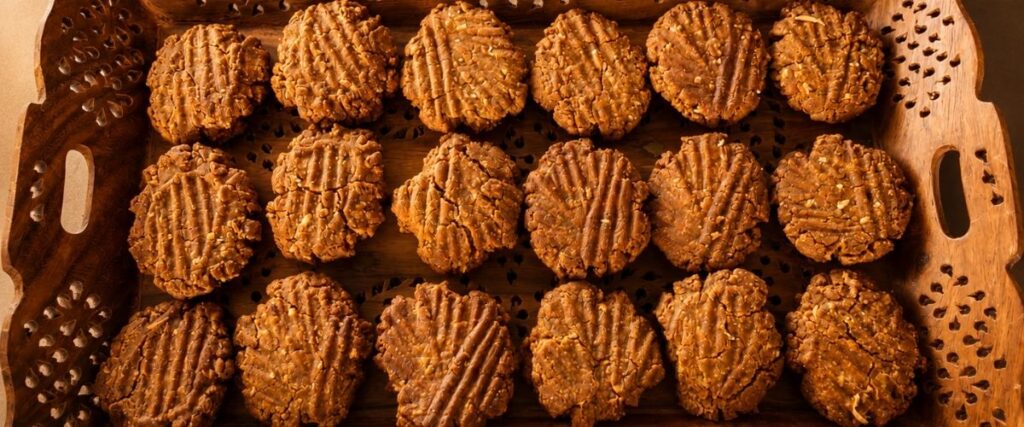
It is pressed into a round or oval disc using a hand-carved wooden mould called a sancha, which imprints a floral or geometric pattern onto the surface. It is fried slowly in desi ghee on a low flame for 12–15 minutes until deep golden brown. It contains no preservatives, no refined flour, no refined sugar, and no artificial flavouring. Its shelf life is 30 days in an airtight container at room temperature.
That is what thekua is. What it is not, despite what most of the internet will tell you, is exclusively a Chhath Puja sweet.
Where Thekua Actually Comes From
Most descriptions of thekua will tell you it’s from Bihar. That’s accurate but incomplete. Thekua is specifically from Mithila, a cultural and linguistic region that predates the state of Bihar by several centuries and extends across the India-Nepal border.
Mithila is defined by the Maithili language, by the Kamala, Gandak, and Koshi rivers, and by a culinary tradition that has remained largely unchanged for generations. Wheat, jaggery, and ghee have been daily kitchen staples in this region for centuries, long before Bihar existed as an administrative state, long before either India or Nepal drew the lines that now divide the region on a map. Thekua is not a recent invention. It is a direct continuation of that tradition.
The distinction between “Bihari” and “Mithila” matters more than it might seem. Bihar is a state. Mithila is a civilisation. When you call thekua a “Bihari sweet,” you’re correct in the administrative sense. But you’re missing the specific cultural context, the Maithili-speaking belt, the kitchen traditions, the sancha mould patterns that echo Madhubani painting, the fact that the same food is made in the same way on both sides of the India-Nepal border, because food has never cared much about where governments drew the lines.
At The Thekua Company, we say Mithila because that’s where this comes from. Not because Bihar is wrong, but because Mithila is more precise.
What Thekua Is Made Of
The Mithila version of thekua, the version made in our kitchen, the version our homemakers grew up making, has four ingredients:
Chakki atta (stone-ground whole wheat flour): Not packaged atta. Not a whole wheat and refined flour blend. Chakki atta, stone-ground, coarser, with the bran intact. The specific grind matters for how the dough absorbs jaggery syrup and for the texture of the finished thekua. More on why this matters, and the full recipe →
Block jaggery (gur): Not powder, not refined sugar. Block jaggery, broken and dissolved into a syrup before being worked into the dough. The syrup method is standard in Mithila kitchens; it gives even distribution and consistent sweetness throughout the dough. The jaggery is what gives thekua its deep amber colour and its mineral content (iron, potassium, magnesium, nutrients that refining strips from white sugar).
Desi ghee: In the dough and as the frying medium. Not oil, not a blend. Pure desi ghee — for the warmth, the aroma, and the 30-day shelf life that no preservative is needed to explain.
Dried grated coconut: The fourth ingredient, and the one most recipes miss. In Mithila’s version, dried coconut goes into the dough, not for coconut flavour, but for texture. It creates a subtle crunch that runs through every bite. This is the detail that separates a recipe that was actually made in a Mithila kitchen from one that was written by someone who researched it online.
That’s it. Four ingredients. No additives. No preservatives. No flavouring agents.
The Sancha: What Makes Thekua Look Like Thekua
Thekua’s characteristic appearance, a round or oval disc with a deeply pressed floral or geometric pattern on the surface, comes from a wooden mould called a sancha.
The word thekua itself is believed to come from “thokna”, to hammer or press, a direct reference to the act of pressing the dough firmly onto the wooden mould. The name describes the action. The action defines the food.
The sancha is hand-carved, typically from hardwood, with a pattern cut into the pressing face. Traditional sancha designs carry the same motifs you find in Madhubani painting, the same geometric flowers, the same radiating patterns, because both traditions draw from the same Mithila visual vocabulary. They are not coincidentally similar. They are the same language, expressed in different materials.
The sancha does more than make thekua look beautiful. It standardises the thickness of each piece, which is what ensures even frying. Thekua pressed by hand without a mould will vary in thickness across pieces. Variation in thickness means variation in frying time. The sancha removes that variable.
Our homemakers at The Thekua Company have been using their sancha for years. The patterns on every piece are the same as their mothers pressed before them.
How Thekua Is Made: The Method in Brief
The process begins with the jaggery, block jaggery dissolved in water over low heat into a syrup, strained of impurities, and left to cool before it touches the flour. Hot syrup added directly to flour creates uneven, sticky dough. Room-temperature syrup creates dough you can work.
The ghee is rubbed into the flour before any liquid is added — a technique that coats the flour proteins and produces thekua’s short, crisp texture rather than a bread-like chew. The dried coconut is mixed in at this stage too.
Then the syrup is added gradually. The dough that forms should feel firm — stiff enough to hold its shape in your palm, not sticky, not pliable like chapati dough. A soft dough absorbs ghee during frying instead of being fried in it. Firmness is not optional.
After resting, the dough is pressed into the sancha and fried in desi ghee on a low flame for 12–15 minutes. Jaggery caramelises faster than refined sugar. High heat burns the outside before the centre sets. The low flame is why thekua tastes the way it does, and why most people who try to make it for the first time on a medium flame get dark outsides and raw centres.
The Everyday Life of Thekua — Before It Became “Festival Food”
Here is the history that most descriptions of thekua skip.
Thekua was not historically a festival food. It was an everyday food, made from wheat, jaggery, and ghee, which are not festival-only ingredients. They are pantry staples. Chakki atta is what every kitchen in Mithila uses for daily roti. Block jaggery is how most traditional Indian households sweetened food before refined sugar arrived. Desi ghee was, for much of Indian culinary history, the default cooking fat.
You don’t make special food from everyday ingredients. You make everyday food. Thekua was in the steel dabba. It was packed for long journeys because it could be kept for weeks without refrigeration. It was eaten with chai. It was the thing children were given after school. The fact that it was also made at Chhath Puja is not the defining fact of its existence; it’s one chapter in a much longer story.
What changed: packaged snacks. Beginning in the late 1980s and accelerating through the 1990s, organised FMCG brands brought biscuits and packaged snacks into tier-2 and tier-3 cities across Bihar, Jharkhand, and eastern UP. Parle-G, Britannia, the wave of glucose and Marie biscuits. These products were convenient, cheap, widely available, and aggressively marketed. Against that, handmade thekua had no marketing, no shelf space outside the home kitchen, and no economic infrastructure to make it available year-round.
So thekua retreated. Not from kitchens, it never left kitchens. But from the everyday eating occasion it had historically occupied. It retreated to Chhath because at Chhath, it was guaranteed to be made. At Chhath, it was ritual, and ritual is harder to displace than habit. And so gradually, thekua became “Chhath food” in the popular imagination, not because that’s what it always was, but because that was the one occasion packaged snacks couldn’t take from it.
This is what The Thekua Company is fixing. Not by restoring thekua to a nostalgic past it can never return to, but by building the commercial infrastructure that should have existed all along, so thekua can be in the kitchen every week, not just once a year.
“When people ask me why I started this, I say: because the food was always there. It was never the food that was missing. The shelf space was missing. The delivery was missing. The packaging was missing. We built those things. The food already knew what it was doing.”
— Neetu Yadav, Co-Founder, The Thekua Company
Thekua on the Global Stage: June 2026
In June 2026, Prime Minister Narendra Modi presented thekua to Richard Raší, Speaker of Slovakia’s Parliament, during the first-ever visit by an Indian Prime Minister to Slovakia since its independence in 1993.
The gesture was covered internationally. For people outside Bihar and Mithila, it was an introduction. For those of us inside it, it was recognition that felt overdue, not because thekua needed a diplomatic moment to be good, but because the food has always been good enough to represent India at any table. It just needed someone to put it there.
The irony is not lost on us: thekua travelled to Bratislava before it had a reliable market in Bengaluru or Pune or most of the Indian cities where people from Mithila have been living for decades, craving a taste of home, buying biscuits instead.
That’s changing.
How Thekua Tastes — and Why It’s Different from What You Expect
If you’ve never had thekua, the closest thing in the common snacking vocabulary is a dense, firm biscuit with a deep, nutty sweetness from jaggery and a warmth from ghee that no factory-made snack has managed to replicate.
But that comparison undersells it. Thekua doesn’t taste like a biscuit made better. It tastes like a completely different category of food, one where the flavour comes from the ingredients themselves rather than from flavouring agents added to make processed ingredients taste like something.
The jaggery gives a complex sweetness, not the flat, single-note sweetness of refined sugar, but something with depth and a slight earthiness. The ghee gives warmth. The whole wheat gives substance. The coconut gives crunch at unexpected moments. The pressed pattern on the surface creates texture variation between the edge and the centre.
It is firm. It is meant to be firm. It does not melt in your mouth. It holds its shape in chai without turning to mush. It keeps in a jar for a month without going stale. These are not limitations — they are what the food is designed to do, and it does them better than almost anything else in the category.
Every batch at The Thekua Company is made by Neetu Yadav and Geeta Singh, both homemakers from Mithila, both of whom grew up making thekua not as a cultural exercise but as a daily act.
Geeta never learned from a written recipe. She learned by watching women who had been doing this for decades, getting it wrong until her hands got it right. The dough consistency, the ghee temperature, the moment the thekua is ready to come out of the kadai, none of it has a timer. Her hands know. Every batch is made to the standard she was taught.
Neetu grew up in a house where the steel dabba was never empty. She built The Thekua Company because the food deserved a market, not just a kitchen. Every batch that leaves is a direct continuation of what she grew up eating.
Thekua is made and sold by The Thekua Company at thekuacompany.com, available in four sizes:
250g Everyday Pack — the right starting size. One week of chai-time snacking.
500g Family Pack — where most buyers land after the first order.
1kg Large Pack — for households that go through snacks quickly, or for gifting.
2kg Bulk Pack — corporate gifting and large families.
All orders ship pan-India. Every batch is made fresh after your order is placed, no pre-made stock, no warehouse. When the thekua arrives, its full 60- 90-day shelf life is ahead of it.
Made in Mithila. By homemakers who never stopped making it.
Frequently Asked Questions
The word thekua comes from "thokna", meaning to hammer or press in Hindi. It refers to the act of pressing the dough firmly onto the wooden sancha mould to create the characteristic pattern. The name describes the making process, not the eating occasion.
Thekua is a traditional fried sweet from the Mithila region of northern Bihar and southern Nepal. It is made from stone-ground whole wheat flour (chakki atta), block jaggery, pure desi ghee, and dried grated coconut. It is pressed into a round or oval disc using a hand-carved wooden mould called a sancha and fried slowly in desi ghee. No preservatives. 60-75-day shelf life.
Thekua is made during Chhath Puja, but it is not exclusively a Chhath food. Historically, thekua was an everyday snack in Mithila, kept in a steel dabba and eaten with chai, after school, during journeys. It became associated primarily with Chhath after packaged snacks displaced it from everyday occasions, but the food itself predates its festival association.
Thekua comes from Mithila, a cultural and linguistic region defined by the Maithili language, spanning northern Bihar and southern Nepal. It is distinct from "Bihari food" broadly, though Bihar is the administrative state it falls within. The same recipe is made on both sides of the India-Nepal border.
Authentic Mithila thekua uses four ingredients: chakki atta (stone-ground whole wheat flour), block jaggery dissolved into syrup, desi ghee, and dried grated coconut. No refined flour, no refined sugar, no preservatives, no artificial flavouring.
The combination of low moisture content, desi ghee (which creates a natural oxygen barrier), and the frying process (which drives residual moisture from the dough) creates conditions that prevent microbial growth. Properly made and stored in an airtight container, thekua lasts 60 days at room temperature.
Thekua has a deep, complex sweetness from jaggery, earthier and less flat than refined sugar. The desi ghee provides warmth and aroma. The whole wheat gives substance. The coconut adds crunch. The texture is firm and dense, not soft or melt-in-mouth. It holds its shape in chai without disintegrating. It is meant to be this way.
Thekua uses whole wheat flour instead of refined flour (maida), jaggery instead of refined sugar, and desi ghee instead of refined palm oil. It contains no emulsifiers, no flour treatment agents, no artificial flavouring, and no preservatives. A biscuit is a factory product designed for convenience. Thekua is a handmade food designed to last, nourish, and taste like something real.
The sancha is a hand-carved wooden mould used to press the thekua dough into a round or oval disc with a floral or geometric pattern on the surface. Traditional sancha designs share their visual vocabulary with Madhubani painting. The mould also standardises the thickness of each piece, which ensures even frying.
In June 2026, Prime Minister Modi presented thekua to Richard Raší, Speaker of Slovakia's Parliament, during his visit to Bratislava, the first Indian Prime Minister to visit Slovakia since its independence. Thekua was chosen as a gift representing Bihar and India's culinary heritage.
The Thekua Company makes and ships handmade thekua pan-India. Every batch is made fresh after your order from chakki atta, block jaggery, desi ghee, and dried coconut. Order here → https://thekuacompany.com//shop/.
About the author
Neetu Yadav
Co-Founder, The Thekua Company & Mithila House
Neetu grew up in Mithila, where thekua was never a festival food; it was just food. The snack in the steel dabba is made every week, without a recipe card. She co-founded The Thekua Company to give that everyday food the everyday market it always deserved. Every batch that leaves the kitchen meets the standard she grew up with.