

There’s a version of this article that would list “10 Amazing Health Benefits of Thekua” and tell you it’s a superfood. That it detoxifies your liver. That it strengthens your bones. That it boosts immunity.
That article already exists, several times over, on several websites. Most of those claims are either exaggerated, taken out of context, or completely unsubstantiated. We’re not writing that article.
Here’s what this one covers instead: The actual thekua nutrition profile, ingredient by ingredient, number by number — based on what we put into every batch at The Thekua Company. What each ingredient genuinely contributes. Where are the real health benefits of thekua? And where the limits of those claims are, because pretending a fried sweet is a health food is not something we’re interested in doing.
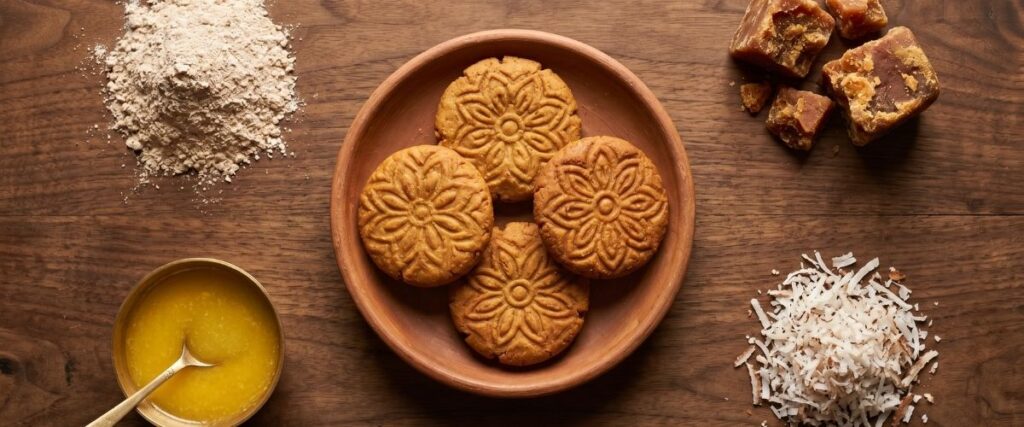
Thekua is a traditional Mithila snack made from four ingredients: chakki atta (stone-ground whole wheat flour), jaggery, desi ghee, and dried grated coconut. Each has a real nutritional profile. But thekua is still a fried sweet. It has calories. It has fat. It has sugar from jaggery. The honest argument is that it’s a meaningfully better snack than what most people default to, not that it’s medicine.
Nutritional Profile: What’s in One Piece of Thekua
A single piece from The Thekua Company weighs approximately 22-35 grams. Here’s the approximate nutritional breakdown:
| Nutrient | Per piece (approx. 35g) |
|---|---|
| Calories | 160–170 kcal |
| Carbohydrates | 22–24g |
| Protein | 2–3g |
| Fat | 7–8g |
| Dietary fibre | 1.5–2g |
| Iron | 1–1.5mg |
| Potassium | 60–80mg |
| Calcium | 10–15mg |
These are estimates based on our actual recipe ratios and the nutritional values of each ingredient from the Indian Food Composition Tables (IFCT 2017). They are not lab-certified numbers, and we’re upfront about that. When lab testing is complete, we’ll update these. For now, they’re the best available picture based on published food science data.
For context: one thekua has roughly the same calories as two Parle-G biscuits. But the macronutrient composition, where those calories come from and how your body processes them, is entirely different. Read the full ingredient-by-ingredient comparison between thekua and biscuits here →
What Whole Wheat Flour Brings to Thekua
Chakki atta is the base of every batch. It makes up the largest proportion of the dough by weight, and it’s the ingredient that separates thekua from most commercial snacks before you even get to the sweetener or the fat.
Whole wheat flour contains roughly 12g of dietary fibre per 100g. Maida, the refined flour that most biscuits are made from, has 2–3g. That difference isn’t abstract. Fibre slows digestion, moderates blood sugar response, and creates the feeling of actually being full after eating. It’s the reason one thekua with chai holds you until dinner while four biscuits don’t. I’ve watched this happen with every person who’s tried our thekua for the first time — they reach for one, maybe two, and then they stop. Not because someone told them to. Because they’re genuinely not hungry anymore. That doesn’t happen with biscuits.
Beyond fibre, whole wheat brings B vitamins, thiamine, riboflavin, and niacin, which are involved in how your body converts food into energy. These vitamins are concentrated in the bran and germ layers, which is exactly what maida refining removes. Chakki atta keeps them.
There’s also iron: approximately 3.5–4mg per 100g of whole wheat flour. In a country where iron deficiency affects roughly half of all women of reproductive age, according to the National Family Health Survey, every dietary source adds up.
And magnesium, about 138mg per 100g. Most people don’t think about magnesium, but it plays a role in over 300 enzymatic reactions in the body, including muscle function and blood sugar regulation.
The honest part: Whole wheat flour is also calorie-dense, at roughly 340 kcal per 100g, and high in carbohydrates. It is nutritionally superior to maida in every measurable dimension, fibre, vitamins, minerals, but it is not a low-calorie ingredient. Thekua made from it is a better snack than a maida biscuit. It is not a diet food.
What Jaggery Contributes (And What It Doesn’t)
At The Thekua Company, the ratio is 500g of block jaggery for every 1kg of atta. The jaggery is dissolved into a syrup before being worked into the dough. [The full method is documented in our recipe post →]. The syrup method is what gives an even sweetness distribution. It’s also how every homemaker in Mithila has always done it.
Jaggery’s standout nutritional contribution is iron. The Indian Food Composition Tables (IFCT 2017) report cane jaggery at 11.4mg of iron per 100g. That’s a significant number. For context, the recommended daily allowance of iron for adult women in India is 21mg (ICMR-NIN 2020). A single thekua won’t meet that need, but it contributes meaningfully, especially when compared to refined sugar, which contains effectively zero iron.
Jaggery also brings potassium (roughly 1000–1050mg per 100g) and magnesium (70–90mg per 100g). Combined with the magnesium from the whole wheat flour, thekua becomes a genuinely reasonable dietary source of this mineral that most Indians are deficient in without knowing it.
Then there’s the glycemic index question. Jaggery’s GI is estimated at 50–65, compared to refined sugar at roughly 65–70. That gap is moderate, not dramatic enough to call jaggery a “low-glycemic” sweetener, but real enough to mean a somewhat slower blood sugar rise than an equivalent amount of refined sugar.
Now the part most thekua nutrition articles won’t tell you: jaggery is still sugar. It still contains sucrose. It still raises blood sugar. The mineral content is real and measurable, and it genuinely makes jaggery a better sweetener than refined white sugar. But “better than refined sugar” is not the same as “healthy.” Anyone managing diabetes or blood sugar conditions needs to treat jaggery with the same caution as any other sweetener.
Some websites claim jaggery “detoxifies the liver” or “purifies blood.” These claims have no backing in clinical research. They may be rooted in Ayurvedic tradition, but they are not evidence-based nutrition, and we don’t use them.
“My mother never thought about iron or magnesium when she made thekua. She thought about whether the jaggery was good — was it clean, was the colour right, did it dissolve properly. The nutrition was always there. She just didn’t need a label to tell her.”
— Geeta Singh, Co-Founder, The Thekua Company
Why Ghee Matters More Than You Think
Ghee appears twice in our thekua, 80–100g in the dough per kg of atta, and then as the frying medium. Every piece is made in desi ghee and fried in desi ghee. No oil. No vanaspati. No shortcuts.
This matters nutritionally for several reasons.
Ghee contains fat-soluble vitamins A, D, E, and K, all of which need dietary fat to be absorbed. This is one reason traditional Indian cooking always paired ghee with grains and vegetables rather than stripping fat out of the meal. The nutritional logic was built into the cuisine long before anyone quantified it.
Ghee is also one of the richest dietary sources of butyric acid, a short-chain fatty acid that serves as a primary energy source for the cells lining your colon. Research associates butyric acid with gut barrier integrity and overall gut health. The evidence is promising, though not yet conclusive enough for definitive claims. What I can tell you from a kitchen perspective, not a lab one, is that people who grew up eating ghee-based foods and then switched to refined oil diets often describe digestive changes. That’s anecdotal, not scientific, but it’s consistent enough across the people I know to be worth noting.
There’s also conjugated linoleic acid (CLA), present in small amounts in ghee from grass-fed cows. Some research links CLA to anti-inflammatory properties, though the quantities in dietary ghee are modest.
And then there’s satiety, the most practically important thing about ghee in thekua. Fat makes you full. The ghee in thekua, both in the dough and from frying, is a major reason why one piece with chai is actually satisfying. This isn’t complicated science. It’s something every grandmother in Mithila already knew.
The caveat, because it matters: Ghee is a saturated fat. Per 100g, it’s roughly 62g saturated. Recent nutrition research has moved away from the old blanket condemnation of saturated fat, but ghee is still 9 calories per gram. more than double the caloric density of carbohydrates or protein. One thekua has 7–8g of fat, primarily from ghee.
Is ghee a better fat than refined palm oil or hydrogenated vegetable oil? Yes, the fatty acid profile is different, and there are no trans fats. But “better than palm oil” is not the same as “good for your heart.” If anyone tells you ghee reduces cholesterol, they’re overstating what the research supports. Context and quantity always matter.
The Coconut Detail Nobody Mentions
Dried grated coconut is the smallest ingredient by weight, 50–60g per kg of atta, and it’s the one that separates our thekua from most other versions you’ll find online. I’ve been asked about it many times. People taste the thekua and notice something in the texture they can’t place. It’s the coconut.
From a nutrition standpoint, coconut brings medium-chain triglycerides (MCTs), fatty acids that your body metabolises differently from the longer-chain fats in most foods. MCTs are absorbed faster and are more likely to be used for immediate energy than stored as body fat. The quantity per piece of thekua is small enough that this isn’t going to change anyone’s health profile on its own. But it adds to the overall energy composition in a way that’s worth knowing about.
Dried coconut also contains roughly 9g of fibre per 100g, which adds to what the whole wheat flour is already providing.
Mostly, though, the coconut is there for the crunch. It creates a subtle texture throughout each piece that you won’t get from thekua made without it. It’s not the kind of thing you’d identify as “coconut flavour.” It’s more of a feeling in the bite, a slight resistance that makes the texture more interesting than it would be with just atta and jaggery alone. This is a Mithila kitchen detail, not a nutrition decision. But it happens to bring real nutrients along with it.
How Thekua Health Benefits Compare to Other Indian Sweets
Context matters more than absolute numbers. Here’s how thekua sits alongside other traditional Indian sweets and the snacks most people actually eat:
| Snack | Calories (per ~40g) | Primary fat | Sweetener | Preservatives |
|---|---|---|---|---|
| Thekua (The Thekua Company) | 160–170 | Desi ghee | Jaggery | None |
| Gulab Jamun (1 piece) | 150–175 | Ghee or oil | Refined sugar syrup | Varies |
| Kaju Katli (2 pieces) | 180–200 | Ghee | Refined sugar | Often present |
| Besan Ladoo (1 piece) | 180–200 | Ghee | Refined sugar | Varies |
| Parle-G (5 biscuits) | 175–185 | Refined palm oil | Refined sugar | BHA/BHT in some |
Thekua’s calorie count is in the same range as most traditional sweets. It doesn’t win on calories. Where it wins is ingredient quality: whole wheat instead of maida, jaggery instead of refined sugar, and the complete absence of preservatives, emulsifiers, and artificial flavourings that show up in factory-made products.
What Thekua Is — And What It’s Not
This section exists because the internet has a habit of turning every traditional food into either a villain or a miracle.
Thekua is a nutritionally substantive snack. Every ingredient, whole wheat flour, jaggery, ghee, dried coconut, contributes real, measurable nutrients. Fibre, iron, potassium, magnesium, B vitamins, fat-soluble vitamins, and butyric acid. These are not marketing claims. They are food composition facts, documented in published databases.
Thekua is not a health food, a superfood, or a dietary supplement. It is a fried sweet with approximately 160–170 calories per piece and 7–8g of fat. Eaten as part of a balanced diet, one or two pieces with chai, the way it’s always been eaten in Mithila — it is a significantly better choice than biscuits made from maida, refined sugar, and palm oil. Eaten in excess, it will contribute to weight gain the same way any calorie-dense food would.
Thekua is not medicine. It does not cure diseases. It does not detoxify anything. Anyone telling you otherwise is overclaiming, and overclaiming eventually destroys the trust that traditional foods have earned over centuries of being genuinely good.
The real claim is simpler and stronger: thekua is an everyday snack made from four real ingredients, each one contributing something your body can actually use. In a country where the default 4 pm snack is made from maida, refined sugar, and palm oil, that’s not a small thing.
It’s enough.
“I know what goes into this. I know because I put it there — every time, for every batch. Atta, gur, ghee, nariyal. That’s it. When people ask me if thekua is healthy, I say — look at what’s in it. Then look at what’s in the packet you’re eating right now. You don’t need me to tell you which is better. You already know.”
— Geeta Singh, Co-Founder, The Thekua Company
If You Want to Try It
Everything in this post is specific to The Thekua Company’s recipe, chakki atta, block jaggery at a 1:2 ratio, desi ghee in the dough and as the frying medium, dried grated coconut. Other sellers may use different ingredients, different ratios, or different methods. The nutritional profile changes when the inputs change.
If the ingredients matter to you, and if you’ve read this far, they probably do:
250g Everyday Pack — ₹229 One piece with chai. Every day. The way it was always meant to be eaten.
Want to make it yourself? Here’s the full recipe and method →
Want to understand how we make it and who we are? →
Made in Mithila. By homemakers who never stopped making it.
Frequently Asked Questions
-
Thekua is made from whole wheat flour, jaggery, desi ghee, and dried coconut, all minimally processed ingredients that contribute fibre, iron, potassium, B vitamins, and fat-soluble vitamins. It is nutritionally superior to biscuits and most packaged snacks sold in India. However, it is a fried sweet with approximately 160–170 calories per piece. It is a better snack choice, not a health supplement. Moderation applies, as it does with any food.
-
Approximately 160–170 calories per piece (roughly 40g). For context, that's comparable to two Parle-G biscuits, but the macronutrient composition is entirely different. The combination of whole wheat, jaggery, and ghee produces a more sustained energy release and higher satiety than the rapid spike-and-drop of maida, sugar, and palm oil.
-
Thekua contains jaggery, which has a moderately lower glycemic index than refined sugar (approximately 50–65 vs 65–70). That means a somewhat slower blood sugar rise. However, jaggery is still a sweetener that raises blood sugar. Anyone managing diabetes should consult their doctor before incorporating thekua into their diet. We do not position thekua as "diabetic-friendly", that framing overstates the science.
-
Yes, that's historically how it was eaten. In Mithila's kitchens, thekua was the everyday snack: kept in a steel dabba on the kitchen shelf, eaten with chai or on its own. One to two pieces per day is a reasonable serving. Like any food, it should be part of an overall balanced diet, not a replacement for meals.
-
The ingredients contribute meaningful nutrients: fibre from whole wheat and coconut, iron from jaggery (11.4mg per 100g per IFCT 2017) and whole wheat, potassium and magnesium from jaggery, B vitamins from whole wheat, fat-soluble vitamins and butyric acid from ghee. These are evidence-based, documented nutritional contributions, not marketing claims.
-
No. The Thekua Company's thekua contains no preservatives of any kind. The 60-75 days shelf life comes from the natural properties of the ingredients and the frying process: low moisture content in the finished product, ghee acting as a natural oxygen barrier, and conditions that don't support microbial growth.
-
No. Jaggery is a traditional unrefined sweetener that retains trace minerals, iron, potassium, magnesium, which are stripped away during the refining process that produces white sugar. That makes jaggery a nutritionally better sweetener. It does not make it a superfood. Claims about liver detoxification and blood purification are not supported by published clinical evidence.
-
A single piece contributes approximately 1–1.5mg of iron, primarily from jaggery and whole wheat flour. The recommended daily intake for adult women in India is 21mg (ICMR-NIN 2020). Thekua is a useful everyday dietary contributor to iron intake, not a standalone source.
-
On ingredient quality, significantly. Thekua uses whole wheat flour instead of maida, jaggery instead of refined sugar, and ghee instead of refined palm oil. It contains no emulsifiers, no flour treatment agents, no artificial flavouring, and no preservatives.

About the author
Geeta Singh
Co-Founder, The Thekua Company & Mithila House