

Bihar is a state. Mithila is not. That’s the simplest version of the distinction, and a good place to start, less a correction than an explanation for why a food brand keeps saying “Mithila” when “Bihar” would be the easier, more familiar word.
What Bihar Is
Bihar is one of India’s 28 states, an administrative and political boundary, drawn and redrawn over the country’s history, currently home to over 100 million people, with its capital at Patna. When most people outside the region hear “Bihar,” this is what they picture: a single state with a single identity.
That picture isn’t wrong. It’s just incomplete.
What Mithila Is
Mithila is a cultural, linguistic, and geographical region, older than the state of Bihar, and not contained by it. Traditionally, its boundaries are marked by the Mahananda River to the east, the Ganges to the south, the Gandaki River to the west, and the Himalayan foothills to the north. In practical terms today, Mithila spans the northern districts of Bihar, including Darbhanga, Madhubani, Samastipur, Saharsa, Sitamarhi, Muzaffarpur, and Purnea, along with parts of Jharkhand, and continues across the border into Nepal’s eastern Terai region.
The defining marker of Mithila isn’t a border on a map. It’s the Maithili language. Maithili is an independent Indo-Aryan language, with its own grammar and historically its own script (Tirhuta, sometimes called Mithilakshar), not a dialect of Hindi. It was added to the Eighth Schedule of the Indian Constitution through the 92nd Constitutional Amendment Act of 2003, giving it recognised status alongside 21 other Indian languages, and was recognised as one of the second official languages of Jharkhand in 2018. Across the border, it’s the second most widely spoken language in Nepal.
Mithila is a distinct cultural geography that happens to fall, today, across two Indian states and one country’s border, not a smaller version of Bihar, and not a region “inside” Bihar the way a neighbourhood sits inside a city. A region like Bengal carries the same kind of identity, one that doesn’t map neatly onto any single modern administrative line.
The region’s older name was Videha, and in the Ramayana it’s remembered as the ancient kingdom ruled by King Janaka — a literary and cultural reference still present in Mithila’s identity today, and part of why Janakpur, across the border in Nepal, remains an important cultural site.
Why Mithila Has Its Own Food Culture
This is where the distinction stops being abstract.
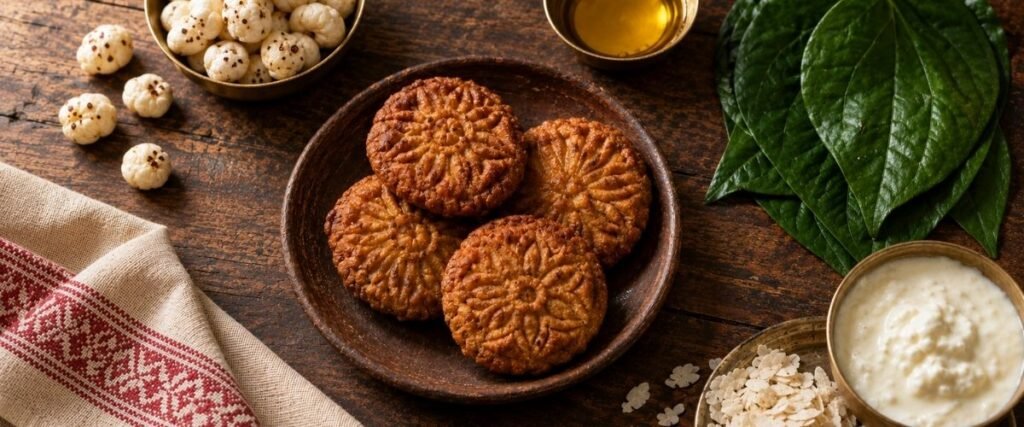
Mithila’s food is built around mustard oil, not the ghee-and-refined-oil combinations more common elsewhere in North Indian cooking. There’s an old Maithili saying, “Maachh, paan aur makhaan, e teen ta aichh Mithila ke jaan” — fish, betel leaf, and makhana (fox nuts) are the soul of Mithila. All three are central to how the region eats, not a decorative phrase.
Maithil Brahmins are among the few Brahmin communities in India that traditionally eat fish, while still avoiding onion and garlic, a specific, unusual combination that doesn’t map onto either a fully vegetarian or fully non-vegetarian Indian food tradition. Breakfast in most Mithila households is dahi-chura, flattened rice with curd, a dish specific enough to the region that it has its own place in how the day is structured, not just what’s eaten.
Even dishes that exist elsewhere in North India take a different form in Mithila. Malpua, for instance, is usually deep-fried and then dipped in sugar syrup across most of North India. In Mithila, the batter itself is sweetened before frying, and the result is a dry preparation that can be stored for two to three days rather than eaten immediately. That same instinct, building sweetness and shelf stability into the food itself, rather than adding it after, is the same logic behind thekua’s own recipe.
None of this makes Mithila’s food “better” than food from elsewhere in Bihar, just specific, its own tradition, with its own internal logic, rather than a regional variation on a shared Bihari template.
Why This Matters for The Thekua Company
We say Mithila, not Bihar, because Mithila is where this recipe comes from, the specific combination of chakki atta, jaggery, desi ghee, and dried coconut, made the way it’s made in Darbhanga and Madhubani and Purnea, is a Mithila recipe with its own internal logic, not a generic “Bihari sweet” that happens to be popular in this particular corner of the state.
Saying “Bihar” isn’t wrong. It’s just the same kind of incompleteness as calling a specific regional French dish simply “European food” — technically accurate, but missing the point of origin that explains why the dish is made the way it is.
More on where thekua comes from →
Meet the homemakers behind every batch →
Made in Mithila. By homemakers who never stopped making it.
Frequently Asked Questions
-
No. Mithila is a cultural, linguistic, and geographical region, not an administrative state. It spans parts of the Indian states of Bihar and Jharkhand, and extends across the border into Nepal's eastern Terai region.
-
Bihar is one of India's 28 states, a political and administrative boundary. Mithila is a cultural and linguistic region defined primarily by the Maithili language, with traditional boundaries marked by the Mahananda, Ganges, and Gandaki rivers and the Himalayan foothills. Mithila spans parts of Bihar and Jharkhand in India, as well as parts of Nepal.
-
No. Maithili is an independent Indo-Aryan language with its own grammar and historically its own script, Tirhuta (also called Mithilakshar). It was added to the Eighth Schedule of the Indian Constitution through the 92nd Constitutional Amendment Act of 2003, and was recognised as one of the second official languages of Jharkhand in 2018.
-
Mithila spans the northern districts of Bihar, including Darbhanga, Madhubani, Samastipur, Saharsa, Sitamarhi, Muzaffarpur, and Purnea, along with parts of Jharkhand, and continues into Nepal's eastern Terai region, including areas around Janakpur.
-
Mithila has its own distinct food culture within the broader region of Bihar, built around mustard oil, fish, and makhana (fox nuts), with dishes like dahi-chura and a version of malpua that differs from how it's made elsewhere in North India. It shares some similarities with the wider food culture of Bihar but follows its own specific traditions.
-
Because that's where the thekua recipe specifically comes from, the ingredients, ratios, and method used at The Thekua Company reflect the Mithila tradition, made in districts like Darbhanga, Madhubani, and Purnea. Saying Bihar is accurate at the state level but doesn't capture the specific regional tradition the recipe belongs to.
About the author
Neetu Yadav
Co-Founder, The Thekua Company & Mithila House