

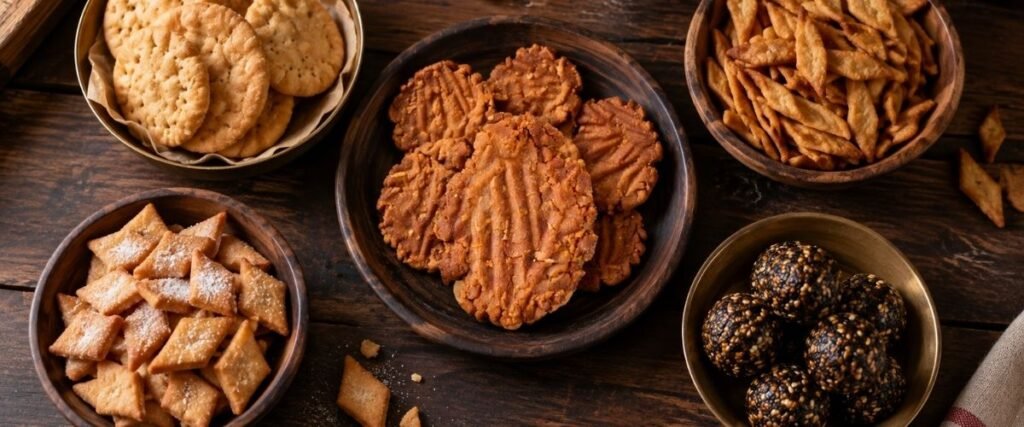
Long before packaged biscuits took over the 4pm snack shelf, every region in India had its own answer to the same question: what do you eat with chai?
The answers were never the same twice. Rajasthan had mathri. North India had nimki. Maharashtra had shankarpali. Winter across half the country meant til ke laddu. Mithila had thekua. Each one came from a different kitchen tradition, used different ingredients, and told you something about the region it came from — but they were all solving the same problem: something to eat alongside tea that wasn’t sweet enough to be dessert and wasn’t a full meal either.
This is a guide to what makes each of these different, and one honest, practical distinction between them that doesn’t get talked about enough: how long they last.
Mathri
Mathri comes from Rajasthan, a flaky, round, savoury biscuit made from refined flour (maida), semolina, yoghurt, and ghee, sometimes with fenugreek leaves or a spice blend worked into the dough. The yoghurt is what gives mathri its particular texture, somewhere between flaky and crumbly. It’s traditionally served with mango, chilli, or lemon pickle, and it travels well; mathri has historically been a food packed for journeys as much as a chai companion, made in large batches and stored in big jars at room temperature.
Typical shelf life: stored properly, mathri generally keeps for a few weeks, commonly cited between two and four weeks in an airtight container, with the exact range depending on the recipe and humidity.
Nimki (Namak Para)
Nimki is one of the most widely made snacks in India, and one with the most regional names. In North India and Bihar, it’s nimki or namak para, ribbon-like or triangular strips of dough made from flour, ajwain (carom seeds), and ghee, deep-fried until crisp. In Maharashtra, it’s called khara shankarpali. In South India, the diamond-cut version is often just called Diamond Cuts. In Karnataka, a version made by pressing the dough through a sev press is called khara sev. Same basic idea- flour, fat, a savoury spice, fried until it snaps- reinvented differently almost everywhere it’s made.
Nimki is usually eaten with chai or alongside a spicy pickle, and it’s a genuine Bihar and Mithila kitchen staple as much as thekua is, often made in the same kitchen, from the same steel dabba, on the same afternoon.
Typical shelf life: two to three weeks in an airtight container, similar to mathri, since the ingredients and frying method are closely related.
Shakarpara
Shakarpara is the sweet counterpart to nimki, diamond-shaped pieces made from whole wheat or refined flour, sugar, and ghee, fried until crisp and lightly sweet rather than savoury. It’s a Diwali staple across much of North India, made in large batches and stored for weeks, often alongside mathri and namak para as part of the same festive frying session.
Typical shelf life: similar to mathri and nimki, a few weeks in an airtight container, since the preparation method (fried, low moisture) is close to the same family of snacks.
Til Ke Laddu
Til ke laddu is different from the others in one important way: it’s genuinely seasonal, not just associated with a season. Made from roasted sesame seeds (til) and jaggery (gud), sometimes with peanuts or coconut added, it’s specifically a Makar Sankranti and Lohri food, eaten across India in mid-January to mark the harvest and the shift toward warmer days. The saying that goes with it, “til gul ghya, god god bola” (take til and gud, and speak sweetly), is as much a part of the tradition as the sweet itself.
Unlike mathri, nimki, or thekua, til ke laddu isn’t really an everyday snack in most households. It’s made once a year, in a specific window, and eaten within that window.
Typical shelf life: roughly ten days to two weeks at room temperature, sometimes longer if refrigerated, noticeably shorter than the fried, low-moisture snacks above, because the ladoo’s soft, chewy texture holds more moisture than a crisp fried snack does.
Thekua
Thekua comes from Mithila, the region spanning northern Bihar and southern Nepal, and it’s made from chakki atta (stone-ground whole wheat flour), jaggery, desi ghee, and dried coconut, pressed into a patterned disc using a carved wooden mould and fried slowly on a low flame. Like nimki, it has historically lived in the same steel dabba as an everyday snack, not only as prasad during Chhath Puja.
Shelf life: 90 days at room temperature in an airtight container, with no preservatives. The full food science behind why it lasts this long →
The Shelf Life Comparison Nobody Talks About
Put these side by side and one thing stands out immediately: thekua’s shelf life is significantly longer than every other snack on this list, and it’s not close.
| Snack | Region | Typical Shelf Life |
|---|---|---|
| Til ke laddu | Pan-India (seasonal) | 4-6 weeks |
| Nimki / Namak Para | North India, Bihar | 2–3 weeks |
| Shakarpara | North India | 2–3 weeks |
| Mathri | Rajasthan | 2–4 weeks |
| Thekua | Mithila | 90 days |
This isn’t a claim that thekua is “better” than any of these, each one is its own tradition, built for its own occasion, and the shorter shelf life of a til laddu has nothing to do with quality. It’s what the ingredients and the moisture content of that specific sweet allow for. But if you’re specifically looking for something that keeps the longest without any preservatives, whether for gifting, stocking up, or sending to someone in another city, thekua’s combination of low-moisture frying, jaggery concentration, and desi ghee puts it in a different category from the rest of this list.
Why thekua specifically lasts this long →
“Every region has its own version of this. Rajasthan has mathri, Bihar has nimki and thekua, Maharashtra has shankarpali. Growing up, ours was thekua — and what I noticed later, once I understood the others, is that ours just lasts longer. That’s not us being better. That’s just what wheat, jaggery, and ghee do when they’re fried the right way.”
— Neetu Yadav, Co-Founder, The Thekua Company
How Thekua Compares to Packaged Biscuits
All five of the snacks above (mathri, nimki, shakarpara, til ke laddu, and thekua) share something packaged biscuits don’t: they’re made from ingredients you can name, without refined palm oil, artificial flavouring, or chemical preservatives. The real comparison worth making is traditional snacks as a whole category against what replaced them in most kitchens over the last three decades, not these regional traditions measured against each other.
Full comparison: thekua vs biscuits →
What happened to India’s everyday snacks →
If You Want to Try Thekua
Every batch at The Thekua Company is made fresh after your order from chakki atta, jaggery or sugar, desi ghee, and dried coconut, with no preservatives and a 90-day shelf life.
The full recipe, if you’d rather make it yourself →
New to thekua? Start with the complete guide →
Made in Mithila. By homemakers who never stopped making it.
Frequently Asked Questions
-
Mathri (Rajasthan), nimki or namak para (North India and Bihar, also called shankarpali in Maharashtra), shakarpara, til ke laddu (seasonal, Makar Sankranti), and thekua (Mithila) are among the most widely made traditional snacks eaten with chai across India.
-
Among common traditional chai-time snacks, thekua has the longest documented shelf life at 90 days at room temperature without preservatives. Mathri typically lasts two to four weeks, nimki and shakarpara around two to three weeks, and til ke laddu roughly ten days to two weeks.
-
They're closely related but not identical. Both are fried, savoury flour-based snacks flavoured with ajwain, but mathri (from Rajasthan) is typically round and made with yogurt in the dough, while nimki (more common in North India and Bihar) is usually ribbon-shaped or triangular. Regional names for similar snacks include shankarpali in Maharashtra and khara sev in Karnataka.
-
Til ke laddu is tied specifically to the Makar Sankranti and Lohri harvest festivals in mid-January, when sesame and jaggery are traditionally eaten together to mark the shift from winter to warmer days. Unlike mathri or thekua, it isn't typically made as an everyday snack outside that festival window.
-
Thekua is made from chakki atta, jaggery, desi ghee, and dried coconut, and its combination of low-moisture frying and ghee gives it a 90-day shelf life, notably longer than mathri, nimki, shakarpara, or til ke laddu. It comes specifically from the Mithila region of Bihar and Nepal.
-
The Thekua Company makes and ships handmade thekua pan-India, made fresh from chakki atta, jaggery or sugar, desi ghee, and dried coconut. Available in 250g, 500g, 1kg, and 2kg at thekuacompany.com.

About the author
Neetu Yadav
Co-Founder, The Thekua Company & Mithila House