Made after you order · 90-day shelf life · Ships across India
Why Thekua Lasts 90 Days Without a Single Preservative
The question comes up with almost every first order. Sometimes in the checkout notes. Sometimes as a message after delivery. Sometimes someone just stares at the jar for a moment and asks out loud.
“How does this last three months without anything added to it?”
It’s a fair question. We’ve been trained, correctly for most packaged foods, to assume that longer shelf life means more additives. Longer shelf life usually means sodium benzoate, BHA, BHT, or some variant of a chemical compound that slows microbial growth. When something lasts a long time and the ingredient list is short, it feels like something is missing.
Nothing is missing. What’s happening in the jar is food science that is older than the preservatives industry by several centuries. This post explains it plainly and completely — what each ingredient does, what the frying process does, and what the jar does. And what actually causes thekua to go bad early, because that’s a real thing and worth knowing.
The Short Answer First
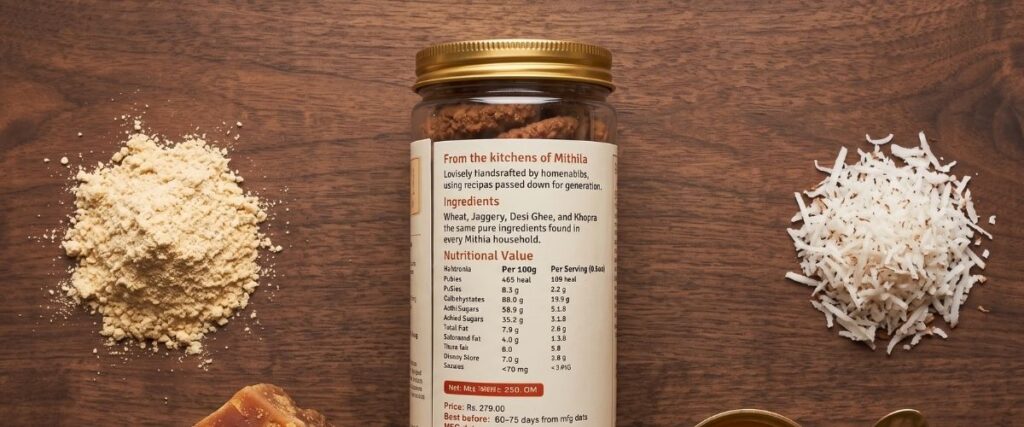
Thekua from The Thekua Company lasts 90 days from the date of making, in an airtight container at room temperature, with no preservatives, no artificial additives, nothing that isn’t already in the ingredient list: chakki atta, jaggery, desi ghee, dried coconut.
The 90-day shelf life comes from four things working together: the near-zero moisture content of the finished product, the natural preservation properties of desi ghee, the high sugar concentration from jaggery, and the airtight glass jar that keeps oxygen and humidity out. Remove any one of these and the shelf life shortens. Keep all four in place, and 90 days is what the food does naturally.
Why Food Spoils — The Short Version
Most food spoilage is caused by microorganisms, bacteria, mould, and yeast that feed on the food and produce waste products that make it inedible. For these microorganisms to do their work, they need two things above almost everything else: moisture and oxygen.
Remove moisture, and microorganisms cannot grow. This is why dried foods — sun-dried mango, dried lentils, dehydrated vegetables, beef jerky — last months without refrigeration. Remove oxygen, and the oxidation process that causes fats to go rancid slows dramatically.
Traditional food preservation, before refrigeration, before chemical additives, was built entirely around these two principles. Pickling in brine. Smoking. Clarifying butter into ghee. Sun-drying. Deep frying in stable fats. All of them achieve the same result through different means: hostile conditions for the microorganisms that cause spoilage.
Thekua uses several of these mechanisms simultaneously.
What Each Ingredient Does
Chakki atta (stone-ground whole wheat flour)
The flour is the structural base of thekua; it makes up the largest proportion of the dough by weight. On its own, flour doesn’t contribute to shelf stability. What matters is what happens to it during the frying process. When thekua is fried at the right temperature for the right amount of time, the moisture inside the dough is driven out almost entirely. What’s left is a dense, dry matrix with very low water content. Microorganisms cannot colonise it.
Jaggery (block gur)
Jaggery contributes to shelf stability through a property called osmotic pressure. High concentrations of sugar in a food create an environment where water is drawn away from microbial cells, essentially dehydrating any bacteria or mould that tries to grow. This is the same principle behind jams, preserves, and crystallised fruits, all of which can last months without refrigeration because of their high sugar content.
The jaggery in thekua, dissolved into syrup and worked evenly through the dough before frying, creates this high-sugar environment throughout every piece. It is not just a sweetener. It is a functional ingredient in the preservation system.
Desi ghee
This is the most important preservation element. Pure desi ghee is clarified butter; the process of making it removes water and milk solids, leaving almost pure stable fat. That removal is what makes ghee one of the most naturally shelf-stable fats in existence. Properly stored, pure ghee lasts 9 to 12 months at room temperature without refrigeration. The science is simple: bacteria need water to survive, and ghee contains almost none.
In thekua, ghee contributes to shelf stability in two ways. First, it coats the flour particles during dough preparation, rubbed in before any liquid is added, creating a fat barrier throughout the dough structure. Second, during frying, ghee penetrates the surface of each piece and creates a thin layer that reduces oxygen exposure on the exterior.
This is not accidental. Ghee has been used as a natural preservative in Indian kitchens for centuries — in pickles, in sweets, in travel foods, precisely because traditional cooks understood that fat keeps oxygen out and extends edibility without any intervention from the outside.
Dried grated coconut
The smallest ingredient by weight. Coconut’s contribution to shelf stability is mainly through its fat content; coconut is high in medium-chain triglycerides, which are stable fats similar in behaviour to ghee. It adds to the overall fat content of the dough, reinforcing the moisture barrier created by ghee. Its primary role in the recipe is textural, the crunch it contributes, but it does not work against the shelf stability the other ingredients create.
What Frying Does
The frying step is where the shelf stability of thekua is built. Everything that happens in the oil is working toward one result: a product with almost no internal moisture.
When raw thekua dough goes into hot desi ghee, the surface sets quickly, creating structure. The internal moisture begins to evaporate and escape as steam. The ghee penetrates the outer layer of the piece simultaneously.
The low flame is critical for this. Thekua is fried on a low flame for 12 to 15 minutes, significantly longer than most fried foods. The reason is jaggery: jaggery caramelises faster than refined sugar, so a medium or high flame burns the outside before the inside sets and dries. The low flame allows the heat to work through the piece evenly and slowly, driving moisture out from the centre before the exterior darkens too much.
What comes out of the ghee at the end of 15 minutes is a piece with very low internal moisture, coated in a thin layer of stable fat, with a high-sugar, low-water interior. This is the condition that produces 90 days of shelf life. Not a chemical. A process.
What the Jar Does
The glass jar with an airtight metal lid completes the preservation system. Once a piece of thekua is correctly made and cooled, the remaining threat to its shelf life is oxygen and external humidity. The airtight jar removes both.
Oxygen causes oxidation, the process by which fats go rancid and flavours deteriorate. An airtight seal slows this to near-zero. Humidity introduces the moisture that low-water-activity food has specifically been made to exclude. The glass jar keeps it out.
This is why the storage instruction is not a formality. The jar must be properly resealed after each use. A jar left open for hours in a humid Indian kitchen is actively shortening the thekua’s life. The food is doing its part. The jar is what makes the system complete.
“My grandmother never calculated shelf life. She knew thekua lasted because she made it right, the dough was firm before it went in, the ghee was right, the flame was low, the pieces were golden all the way through. When all of that was right, the thekua lasted. When something was off, it didn’t. The 90 days is just a number that confirms what she already knew by touch.”
— Geeta Singh, Co-Founder, The Thekua Company
What Actually Causes Thekua to Go Bad Early
90 days is what happens when everything is done correctly and stored correctly. Here is what shortens it.
Moisture exposure during storage: The most common cause. Wet hands entering the jar. A lid left off for too long in a humid environment. Condensation inside the jar if the thekua was stored while still slightly warm. Moisture enters the low-water-activity environment that protects the thekua, and mould can begin to grow.
The fix: always use dry hands or a dry utensil to remove pieces. Always reseal the jar immediately. Never store thekua that is still warm from the kitchen.
Underfrying during making: A piece that wasn’t fried long enough retains more internal moisture than it should. This piece will soften faster and potentially spoil faster than a correctly fried one. In a mixed batch where some pieces are underdone, those pieces are the first to go.
This is why Geeta smells and tastes every batch before it ships. The aroma, the crunch, the colour — if any of these are off, the batch doesn’t go out. A piece that doesn’t pass the check has a compromised shelf life, regardless of what the jar does.
Heat and direct sunlight: Not a spoilage risk in the same sense as moisture, but heat and UV exposure accelerate oxidation of the fats in the thekua and ghee. A jar sitting on a windowsill in direct afternoon sun will taste noticeably different at 60 days than one kept in a cool cupboard. Store away from direct light and heat.
Low-quality ingredients: Adulterated jaggery that contains moisture-retaining additives will produce a thekua with higher water content than intended. Ghee that has been mixed with vegetable fat loses the preservation properties of pure clarified butter. The 90-day shelf life is specific to thekua made with pure block jaggery, pure desi ghee, and chakki atta. Substituting any of these changes the chemistry.
How This Compares to Industrial Preservatives
Commercial biscuits, packaged sweets, and most processed snacks use chemical preservatives to extend shelf life: BHA (butylated hydroxyanisole), BHT (butylated hydroxytoluene), sodium benzoate, and potassium sorbate. These chemicals work by disrupting the biological processes of microorganisms or by acting as antioxidants to slow fat oxidation.
Thekua achieves the same outcomes through physical and chemical properties inherent to the ingredients: antimicrobial protection from low water activity, oxidation prevention from the ghee barrier, humidity and oxygen exclusion from the airtight jar.
The result is 90 days of shelf life with four ingredients. Most commercial snack labels have dozens. The mechanism is entirely different.
Storage Instructions
Where: Cool, dry place — a kitchen cupboard, away from the stove, away from direct sunlight. Not the refrigerator; condensation inside a cold jar introduced to room temperature can add moisture.
Container: The airtight glass jar thekua arrives in is the right container. Do not transfer to a loosely sealed container.
After opening: Reseal immediately after each use. Use dry hands or a dry utensil.
Signs it’s gone bad: Softness where there was crunch, a stale or off smell, visible moisture inside the jar. Any of these before 90 days usually indicates a storage issue, not a product issue.
What doesn’t shorten shelf life: The number of times you open the jar, as long as you reseal it correctly and use dry hands. The jar can be opened daily for 90 days, and the thekua will stay good.
Why This Matters for How You Buy It
Every order at The Thekua Company is made fresh after it’s placed. The thekua arrives within a few days of being made — which means when it reaches you, the full 90-day shelf life is ahead of it, not behind it.
You can order for a festival 3 months away and the thekua will still be at its best when it arrives. You can gift it to someone in another city without worrying that it will go bad before they open it. You can keep it in the kitchen and eat from it every day for months. That’s what it’s designed to do.
Made in Mithila. By homemakers who never stopped making it.
Frequently Asked Questions
Thekua from The Thekua Company lasts upto 90 days from the date of making, stored in an airtight container at room temperature. This applies to both the jaggery and sugar variants.
No. Thekua should be stored at room temperature in an airtight container. The refrigerator is not recommended. Condensation forms when a cold jar is brought back to room temperature, and that moisture is exactly what shortens the shelf life.
Four things working together: very low internal moisture from the frying process, high sugar concentration from jaggery, the natural preservation properties of desi ghee, and an airtight jar that prevents oxygen and humidity exposure. No chemical preservatives are needed because the physical conditions inside the jar are inhospitable to microbial growth.
Pure desi ghee is clarified butter with almost all water and milk solids removed, making it one of the most naturally shelf-stable fats available. Pure ghee itself lasts 9 to 12 months at room temperature without preservatives. In thekua, ghee coats the dough structure from inside and creates a surface barrier that limits oxygen exposure. It functions as a preservation ingredient as much as a flavour one.
Yes. Both variants last upto 90 days. The sugar variant uses block sugar rather than block jaggery, both achieve the same osmotic pressure effect that inhibits microbial growth.
Almost always moisture exposure. Wet hands entering the jar, leaving the lid off in a humid environment, or storing thekua that was still slightly warm when jarred. Reseal the jar immediately after each use and use dry hands or a dry utensil.
The 90-day figure is the period over which we guarantee the texture and flavour will be as intended. Thekua made and stored correctly may remain safe beyond 90 days, but texture and aroma will begin to change. We recommend consuming within 90 days from the date of making.
Most fresh mithai lasts 2 to 3 days. Most packaged sweets use chemical preservatives to extend this. Thekua's 90-day natural shelf life comes from its specific combination of ingredients and process, fried in ghee, high jaggery concentration, very low moisture, which most other sweets don't have.
About the author
Geeta Singh
Co-Founder, The Thekua Company & Mithila House
Geeta never learned thekua from a written recipe. She learned by watching, standing next to women who had been doing it for decades, getting it wrong until her hands got it right. The dough consistency, the ghee temperature, the moment it\'s ready to come out, none of it has a timer. Her hands know. Every batch at The Thekua Company is made to that standard.