Made after you order · 90-day shelf life · Ships across India
Thekua vs Biscuits: What You’re Actually Eating at 4pm
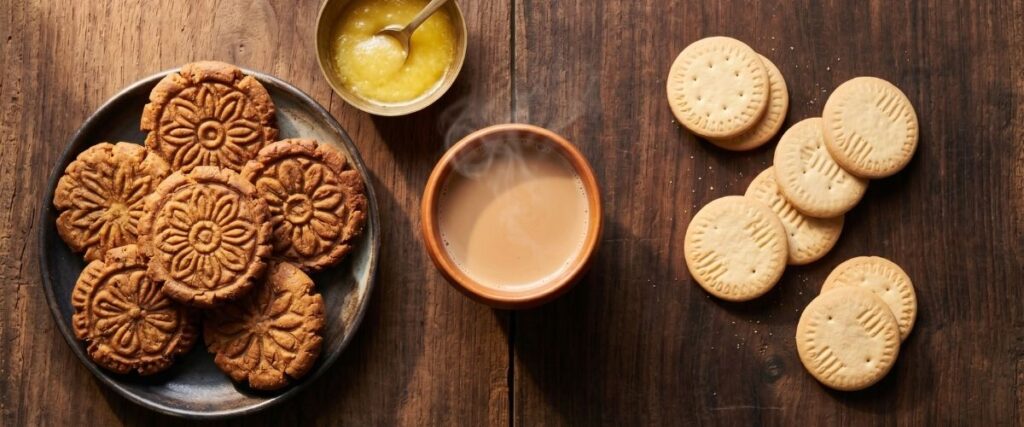
It’s 4 pm. The chai is ready. You reach for whatever’s in the kitchen, and nine times out of ten, it’s a packet of biscuits.
Nobody planned this. Nobody compared options and decided that a Parle-G or a Marie Gold was the ideal thing to eat with chai. It’s just what was there. What was available. What was convenient. And after twenty years of that default, it stopped feeling like a choice and started feeling like the only option.
It isn’t.
This post is a side-by-side comparison of what’s actually in the biscuit you’re eating at chai time versus what’s in a thekua. No shaming. No lectures about clean eating. Just ingredients, laid out clearly, so you can see what you’re choosing between.
The Ingredient Comparison
Let’s start with what’s actually in each product. Not marketing claims. Not packaging headlines. The ingredient lists.
What’s in your biscuit
Pick up a packet of Parle-G Gold, Britannia Marie Gold, or any of the popular glucose or Marie biscuits that sit in most Indian kitchens. Turn it over. The ingredient list reads something like this:
That’s 10+ ingredients, and the first three, maida, sugar, and palm oil, make up the vast majority of the biscuit by weight. In Parle Marie biscuits, refined wheat flour alone is 74% of the product.
Four ingredients. Every single one you can name, picture, and find in a kitchen. No additives. No emulsifiers. No artificial flavouring.
That’s not a marketing angle. That’s just what the two products are made from.
Ingredient by Ingredient: What the Difference Actually Means
Flour: Maida vs Chakki Atta
The base of almost every commercial biscuit in India is maida, refined wheat flour. Refining strips out the bran and the germ, which is where the fibre, the B vitamins, and the minerals live. What’s left is essentially starch. It’s white, it’s smooth, it bakes predictably, and it has almost no nutritional value beyond calories.
Thekua uses chakki atta, stone-ground whole wheat flour with the bran intact. It has roughly 3 to 4 times the fibre of maida, which affects how quickly your body processes it. Maida gets digested rapidly and spikes blood sugar. Whole wheat digests more slowly and releases energy more gradually. At 4 pm, that difference matters — it’s the difference between a quick spike followed by a slump at 5:30, and sustained energy that carries you to dinner.
Sweetener: Refined Sugar vs Jaggery
Biscuits use refined white sugar. Refining removes molasses and with it, trace minerals like iron, potassium, magnesium, and calcium. What remains is pure sucrose, sweetness and calories with nothing else.
Thekua uses jaggery, unrefined cane sugar that retains those trace minerals because it isn’t processed through the same industrial refining. Per 100g, jaggery contains roughly 10–13mg of iron, 70–90mg of magnesium, and 1000–1050mg of potassium. Refined sugar contains effectively zero of all three.
An honest caveat here: jaggery is still a sweetener. It still contains sugar. It’s not a health food in isolation. But when the question is “refined sugar or jaggery,” the nutritional gap is real and measurable. Not marginal — significant.
Fat: Refined Palm Oil vs Desi Ghee
This one deserves a closer look because “oil” and “fat” tend to get lumped together, and they shouldn’t be.
Most commercial biscuits use refined palm oil. It’s cheap, it’s shelf-stable, and it’s flavourless, which is exactly why the food industry loves it. But refined palm oil is high in saturated fat and, depending on the refining process, may contain trace levels of process contaminants. It also contributes nothing to flavour; the taste in your biscuit comes from artificial flavouring substances added separately.
Thekua uses desi ghee, both in the dough and as the frying medium. Ghee is also a saturated fat, so this isn’t a simple “good fat vs bad fat” story. But ghee has a meaningfully different fatty acid profile. It contains butyric acid (a short-chain fatty acid associated with gut health), conjugated linoleic acid, and fat-soluble vitamins A, D, E and K. It also contributes directly to flavour and aroma; the ghee isn’t hiding behind a flavouring agent, it is the flavour.
The other difference is volume. A thekua is a small, dense piece; you eat one or two with chai. A pack of biscuits, because they’re light and low in satiety, tends to get consumed four or five at a time. The fat-per-sitting comparison shifts significantly when you account for how much people actually eat.
The Extras: What’s in the Biscuit That Isn’t in the Thekua
Beyond the three core ingredients, commercial biscuits contain:
Invert sugar syrup — an additional sugar form that improves shelf life and texture in industrial baking. More sweetener on top of the sugar already listed.
Raising agents — sodium and ammonium bicarbonates. These make the biscuit light and airy. Thekua doesn’t use them because thekua isn’t meant to be light — its dense, firm texture is by design.
Flour treatment agents — chemicals that modify the flour’s behaviour during industrial processing. One commonly used agent is sodium metabisulfite, which some people are sensitive to.
Emulsifiers — used to keep the oil and water components from separating. Necessary in factory production, unnecessary when you’re making something by hand with three ingredients and ghee.
Artificial flavouring substances — vanilla flavouring in most cases. The biscuit itself, made from maida, sugar and palm oil, doesn’t have a naturally appealing flavour. The flavouring is what makes it taste like something.
Thekua has none of these. Not because we removed them. Because a product made from atta, jaggery and ghee never needed them.
The 4pm Question: What Actually Happens After You Eat Each One
This isn’t about calories alone. It’s about what happens in the two hours after your chai break.
A glucose biscuit, maida, sugar, and palm oil are rapidly digested. Blood sugar rises quickly, you feel a short burst of energy, and then it drops. By 5:30 or 6 pm, you’re hungry again. Often for more sugar. This cycle is well-documented in nutrition research on high-glycemic, low-fibre snacks.
A thekua, whole wheat, jaggery, ghee, digests differently. The combination of fibre from chakki atta, fat from ghee, and the slower-release sugars in jaggery produces a flatter, more sustained energy curve. You eat one piece with chai, and you’re genuinely not hungry until dinner. Not because you’re suppressing appetite, but because the macronutrient combination actually sustains you.
This is the practical, everyday argument that matters more than any nutritional comparison table. Thekua holds you. Biscuits don’t.
“When I was growing up, nobody called thekua healthy. Nobody called it an alternative to anything. It was just what we ate, with chai, after school, whenever. Then biscuits took over because they were packaged, available and easy. We didn’t choose biscuits. We just ran out of options. The Thekua Company puts that option back.”
— Neetu Yadav, Co-Founder, The Thekua Company
What This Comparison Is Not
Let’s be honest about what this post is and isn’t doing.
This is not a medical claim. We’re not saying thekua prevents diabetes or cures anything. It’s a snack. It’s a better snack than a biscuit made from maida, sugar and palm oil, for specific and verifiable reasons, but it’s still a snack.
This is not a shaming exercise. If you eat biscuits, that’s fine. Most of us grew up eating them. The point is that most people eat biscuits by default, not by choice, and when you actually compare what’s in each one, the choice becomes clearer.
This is also not a claim that thekua is “zero guilt” or “calorie free”, language that cheapens the product and insults the reader. Thekua contains wheat, jaggery and ghee. It has calories. It has fat. What it doesn’t have is maida, refined sugar, palm oil, emulsifiers, flour treatment agents, or artificial flavouring. That’s the difference, and it’s enough.
Low — rapid digestion, hunger returns within 1–2 hours
Higher — fibre + fat + slow-release sugar
Shelf life mechanism
Preservatives + low moisture
Ghee + frying process + low moisture (no preservatives)
Made by
Factory production line
Homemakers in Mithila, by hand
“People ask me, how does thekua last 30 days without preservatives? I tell them — we didn’t add anything to make it last. We just make it properly. When the dough is right, when the ghee is right, when the frying is done on low flame for long enough, the food takes care of itself. That’s how it has always worked.”
— Geeta Singh, Co-Founder, The Thekua Company
What We’re Actually Suggesting
We’re not asking you to give up biscuits forever. We’re asking you to try one swap.
Next time you’re making chai, at 4 pm, or on a Sunday morning, or when someone visits, open a jar of thekua instead of a packet of biscuits. Eat one piece. See how it holds you. See if you need a second. See what your family thinks.
That one swap is how most of our customers started. A 250g jar, a chai break, and then the realisation that this was always better than what they were defaulting to.
Made in Mithila. By homemakers who never stopped making it.
Frequently Asked Questions
Thekua is made from whole wheat flour, jaggery and desi ghee, all minimally processed ingredients. Commercial biscuits are primarily made from refined flour (maida), refined sugar and refined palm oil, with added emulsifiers, raising agents, flour treatment chemicals and artificial flavourings. On fibre content, mineral retention, and ingredient quality, thekua is meaningfully better. That said, thekua is still a snack, not a health supplement. The comparison is relative, not absolute.
A single thekua piece (approximately 40g) has roughly 160–170 calories. Two Parle-G biscuits have approximately 140 calories. The difference is in what those calories are made of, and in how many you eat. Biscuits are light and low in satiety, so people tend to eat 4–5 per sitting. Thekua is dense and filling; most people eat 1–2 with chai. The per-sitting comparison matters more than the per-piece comparison.
Yes, that's exactly what it was originally. In Mithila's kitchens, thekua was the everyday snack, kept in a steel dabba on the shelf and eaten with chai or on its own. It only became "festival food" after packaged biscuits took over its everyday space. The Thekua Company is built to restore that everyday positioning.
Jaggery retains trace minerals (iron, potassium, magnesium) that refining removes from white sugar. Its glycemic index is slightly lower, meaning it raises blood sugar somewhat more gradually. However, jaggery is still a sweetener and should be consumed in moderation. The advantage is real but not unlimited, it's a better form of sweetener, not a health food on its own.
No. The Thekua Company's thekua uses only chakki atta (stone-ground whole wheat flour). No maida, no maida-atta blend, no refined flour of any kind.
The combination of fibre (from whole wheat), fat (from ghee), and slower-digesting sugars (from jaggery) produces a more sustained energy release than the rapid spike-and-drop cycle of maida + refined sugar + palm oil. This is standard nutritional science around macronutrient combinations and glycemic response.
About the author
Neetu Yadav
Co-Founder, The Thekua Company & Mithila House
Neetu grew up in Mithila, where thekua was never a festival food; it was just food. The snack in the steel dabba is made every week, without a recipe card. She co-founded The Thekua Company to give that everyday food the everyday market it always deserved. Every batch that leaves the kitchen meets the standard she grew up with.