

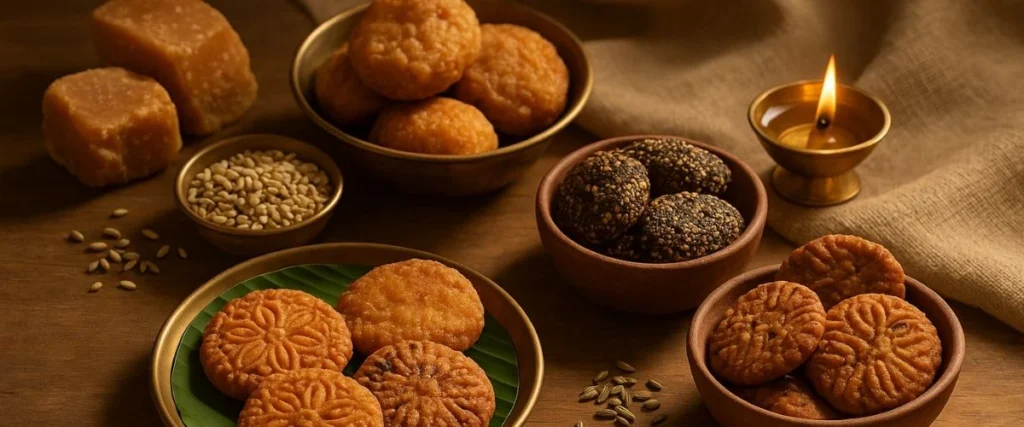
Thekua Across Regions: A Sweet Journey
If you think thekua is just thekua everywhere, you probably haven’t travelled enough—or tasted enough.
This humble prasad, made from wheat, jaggery, and ghee, seems simple at first glance.
Each community has shaped thekua to reflect its own identity, environment, and traditions.
Let’s embark on this sweet journey across borders and see how one timeless recipe connects us all.
From Mithila to Bratislava: Thekua on the Global Stage
In June 2026, Prime Minister Narendra Modi presented thekua to Richard Raší, Speaker of Slovakia’s Parliament, during the first-ever visit by an Indian Prime Minister to Slovakia since its independence in 1993.
The gesture put a food that millions of families in Bihar, Jharkhand, and Mithila have been making for generations onto an international diplomatic stage. For those of us who grew up with thekua in the kitchen, not as a cultural artefact but as a 4 pm snack, the recognition felt overdue. Not because thekua needed validation from a state visit. But because the food itself has always been good enough to travel. It just never had the platform.
What the moment highlighted is something we’ve always known at The Thekua Company: thekua is not a regional curiosity. It’s a genuinely excellent food, made from whole wheat, jaggery, and ghee, that happens to have stayed invisible to most of India and all of the world because nobody built a market for it outside festival season.
That’s changing.
Order handmade thekua, the same food, made the same way, shipped across India →
The Mithila Masterpiece: Where It All Began
In the heartland of Mithila — stretching across parts of Bihar and Nepal — thekua isn’t just made, it’s crafted.
Women gather around brass plates and wooden moulds (sancha), pressing intricate floral and geometric patterns into the dough.
The Mithila version uses the simplest possible ingredient list:
- chakki atta,
- block jaggery,
- desi ghee, and
- dried grated coconut for texture.
No fennel. No cardamom. No spice blends. The flavour comes from the ingredients themselves and the slow ghee-frying method, not from additions.
After the rituals, distribution begins — a festival in itself.
The Bhojpuri Boldness: Go Big or Go Home
Travel west, into Bhojpuri country — eastern Uttar Pradesh and western Bihar — and thekua takes on a bold personality.
The thekua is thicker and larger, designed to sustain after fasting and work.
Key characteristics:
- More jaggery for deeper sweetness
- Grated coconut for moisture
- Til (sesame seeds) for nuttiness
Bhojpuri hospitality ensures nobody leaves empty-handed.
Tradition highlight:
The travelling thekua basket — shared across families and neighbourhoods.
The Magahi Method: Spice Is Nice
In the Magadh region, thekua becomes spiced and complex.
Spice blend:
- Sonth (dry ginger powder)
- Pipali (long pepper)
- Black pepper and ajwain
This variation has Ayurvedic roots and aids digestion.
Popular pairing:
Thekua with kheer or rabri for a rich combination.
The Jharkhand Journey: Forest Flavours
In Jharkhand, thekua reflects forest-based living.
Regional ingredients:
- Mahua flowers for natural sweetness
- Sal seed flour for earthy texture
Some families roast instead of deep-frying.
Community practice:
Shared preparation and equal distribution among families.
The Nepali Narrative: Altitude Adjustments
In Nepal, thekua adapts to altitude and climate.
Unique ingredient:
- Chaku — a rich molasses-like sweetener
Often paired with sel roti during festivals.
Presentation style:
Stacked on brass thalis and distributed by tradition.
The Creative Crossovers: Festival Fusion
Some modern adaptations have experimented with baking, air-frying, or fusion formats. These can be interesting explorations, but they produce a fundamentally different product. The texture, flavour, and shelf stability of traditional thekua come specifically from the ghee-frying process. At The Thekua Company, we don’t adapt the method. The recipe hasn’t changed because it doesn’t need to.
The Unifying Thread
Despite variations, the soul of thekua remains unchanged.
It is still made with wheat, jaggery, and ghee — and prepared with devotion.
Traditional foods adapt without losing identity.
A Living Tradition
Thekua continues to evolve with its people.
Regional reflections:
- Mithila → artistry and grace
- Bhojpuri → strength and generosity
- Magahi → wisdom and balance
- Jharkhand → harmony with nature
- Nepal → resilience
Thekua proves that tradition is flexible, proud, and timeless.
Wherever You Are, You’re Home
At The Thekua Company, we honour all these stories.
Our handmade thekuas are crafted traditionally while celebrating diverse flavours.
Whether near or far from home, the taste remains familiar.
👉 Order handmade thekua online and experience the sweetness that unites us all — across communities, continents, and generations.

About the author
Neetu Yadav
Co-Founder, The Thekua Company & Mithila House