The Language Written in Wood
There’s a quiet, sacred moment in the making of thekua — one that transforms it from a simple sweet into something divine.
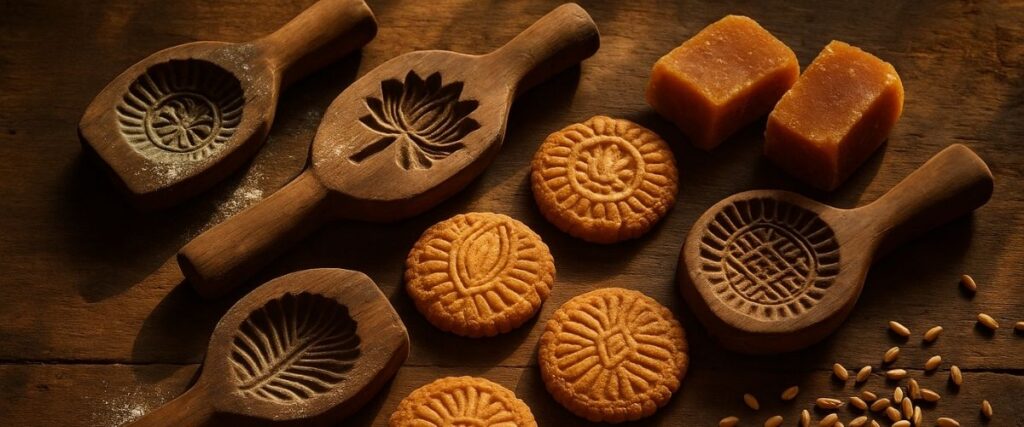
It happens when skilled hands press a wooden mould — the saancha — into soft dough. In that instant, a plain disc of wheat and jaggery becomes a sun, a lotus, a leaf, a prayer.
But those designs aren’t just decoration. Each line, each curve, each petal carved into the saancha carries meaning.
The Language Written in Wood
Walk through any traditional market in Bihar or eastern Uttar Pradesh before Chhath Puja, and you’ll find rows of saanchas.
Each is unique. None is machine-made.
The wood matters. Mango and sheesham are the most common.
But it’s the designs that tell the real story.
The Sun: The Ultimate Offering
The sun motif is the most iconic design.
When you offer a sun-patterned thekua to Surya Dev, you’re creating a reflection.
Symbolism of rays:
- 8 rays for the eight directions, seeking protection from all sides.
- 12 rays for the twelve months, ensuring prosperity throughout the year.
- 16 rays for the sixteen kalas, symbolising completeness.
It’s sacred geometry — simple yet cosmic.
The Lotus: Purity Rising from Water
If the sun represents light, the lotus represents purity.
The lotus, growing in muddy water yet blooming clean, symbolises spiritual purity.
The lotus is also the flower of creation and rebirth.
Symbol meanings:
- Full lotus symbolises enlightenment
- Bud symbolises potential
The Leaf: Nature’s Offering Plate
The leaf pattern connects thekua directly to the earth.
Leaf meanings:
- Peepal leaf: wisdom and longevity
- Mango leaf: auspiciousness and fertility
- Banana leaf: abundance and prosperity
The leaf also reminds devotees of our dependence on nature.
The Fish: Abundance and Flow
Fish symbolise abundance, fertility, and good fortune.
Offering fish-patterned thekua becomes a prayer for balance and sustenance.
The Geometric Divine
Some saanchas are purely geometric — circles, hexagons, mandalas.
Geometric meanings:
- Circle symbolises infinity and unity
- Hexagon represents harmony of opposites
- Eight-pointed star calls protection and prosperity
These transform the prasad into edible yantras.
The Composite Designs: When Symbols Dance Together
The most elaborate saanchas blend multiple symbols.
These composite designs carry layered prayers.
The Artisan’s Touch
None of this exists without the artisans.
They treat their craft as worship.
When you buy a hand-carved saancha, you’re receiving a piece of spiritual heritage.
The Ritual of Pressing
Pressing the saancha into the dough is its own ritual.
The moment the saancha lifts away is quietly awe-inspiring.
Each thekua becomes both food and philosophy.
Preserving a Vanishing Art
This sacred craft faces extinction.
Plastic moulds threaten to replace wooden saanchas.
But hope remains through revival efforts.
What Your Saancha Says About You
Symbol meanings:
- Sun → devotion and clarity
- Lotus → purity and growth
- Leaf → gratitude for nature
- Fish → abundance and joy
- Geometry → harmony and balance
Each choice becomes an expression of faith.
Unity in Patterns
At any Chhath ghat, you’ll see hundreds of thekuas — each different, each message the same.
This is what saancha teaches us: diversity held together by devotion.
Conclusion: When Wood Becomes Prayer
Next time you see thekua — look closely.
Every saancha carries a message: that faith can be held in your hands.
That’s the sacred art of the saancha.
About the author
Neetu Yadav
Co-Founder, The Thekua Company & Mithila House