
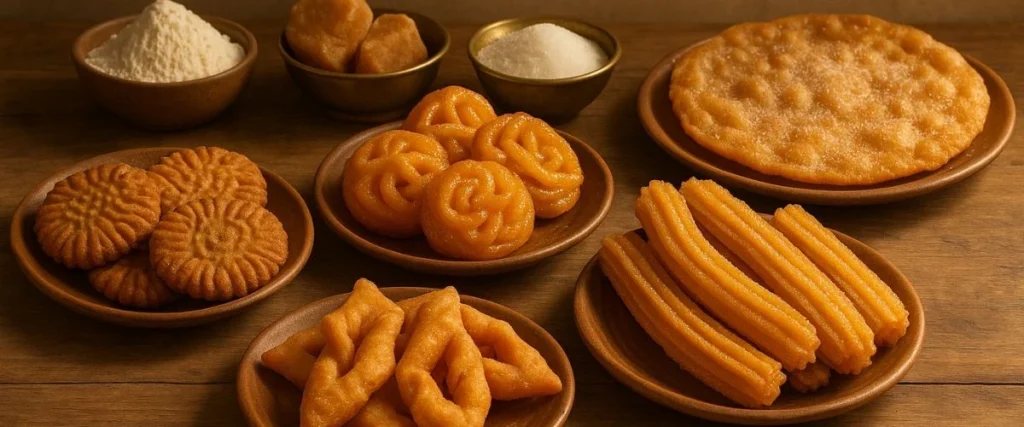
The Thekua Connection: How One Sweet Unites the World
My mom makes thekua with the precision of a scientist and the devotion of a priest. Wheat flour, jaggery, ghee, and a hint of fennel. She kneads the dough until it’s soft but firm, shapes each piece with her thumbs, and slides them into shimmering hot oil. Within minutes, the kitchen smells like childhood, celebration, and something ineffably sacred.
Last year, I showed her a photo of a Danish pastry called klejner. She squinted at my phone and said, “That’s just thekua with a different shape.”
She wasn’t wrong. And that single comment sent me on a journey across continents — from Bihar to Copenhagen, Cairo to Seoul, Mexico City to Kyoto — tracing the surprising ways in which one humble idea has united humanity across time and geography.
Turns out, the world has been making thekua all along. We’ve just been calling it by different names.
The Thekua Formula: A Global Love Story
Let’s break it down.
Thekua’s essence is simple yet genius:
- Wheat or grain flour for structure
- Jaggery or sugar for sweetness and preservation
- Ghee or oil for richness
- A touch of spice — fennel, cardamom, maybe nutmeg
- Hot oil to turn it all golden, crispy, and divine
It’s festive. It’s shareable. It keeps for days without spoiling. It’s both offering and indulgence.
Now, hold that thought — and travel with me.
Middle East & North Africa: Where Sugar Meets Syrup
Walk through Cairo during Ramadan, and you’ll find vendors frying zalabiya — crispy golden dough balls drenched in rose-scented syrup.
Travel west to Tunisia and Algeria, and you’ll meet makroudh.
In Morocco, grandmothers bake ghriba.
Across the Middle East, every household has a version of this story — sweet dough, heat, and devotion.
East & Southeast Asia: The Crispy Chronicles
If you visit Japan, try karintō.
Cross over to Korea, and you’ll find kkwabaegi.
In Malaysia, kuih bahulu makes an appearance.
Each of these embodies the same truth: we all crave sweetness wrapped in effort and memory.
Europe: The Old World’s Sweet Secrets
In Spain, it’s churros.
In Denmark, there’s klejner.
In Italy, you’ll find taralli dolci.
Across Europe, festivals smell the same.
Latin America: Where Continents Collide
Sail west, and you’ll find buñuelos waiting.
In Chile, sopaipillas take centre stage.
Wherever you go, you’ll find that festivals taste the same.
The Pattern Behind the Pastry
At some point, you stop seeing coincidence and start seeing a connection.
Why it works:
- Wheat flour is abundant and versatile.
- Sugar or jaggery adds sweetness and shelf life.
- Ghee or oil brings richness and texture.
- Deep-frying locks in freshness.
Our ancestors solved the same problem — how to make something that honours gods, nourishes families, and endures time.
Borders Are Political, Kitchens Are Universal
Political borders are new. Recipes are ancient.
That’s the real magic of thekua.
The Festival Factor
- Thekua for Chhath Puja
- Zalabiya for Ramadan
- Klejner for Christmas
- Buñuelos for the New Year
- Makroudh for Eid
- Churros for village fairs and holidays
We make them when time feels sacred.
What Our Grandmothers Already Knew
My mom was right — klejner is thekua with a different shape.
Every grandmother who fries something golden and sweet is part of an unspoken sisterhood.
The Recipe for Understanding
In a world obsessed with differences, thekua offers a gentle reminder: we’re more similar than we think.
When you bite into a thekua — or a churro, or a buñuelo — you’re connecting to thousands of years of human history.
So yes, we’re divided by borders. But in the kitchen? We speak one language.
Pass the thekua. Or the churro. Or the klejner. At this point, it’s all one delicious family.
About the author
Neetu Yadav
Co-Founder, The Thekua Company & Mithila House